Early childhood intervention activities for babies by 0 to 6 months age
Early stimulation consists of a series of actions and exercises that will help babies develop and strengthen their emotional, cognitive, motor and social skills during infancy.
These stimulation techniques are most effective at the time of life when the most neural connections are created, which corresponds to the period from 0 to 6 years of age. Neuron formation continues in later years, but to a much lesser extent.
The early stimulation exercises and techniques that can be used are adapted to each age group and start from birth.
The different sections of this article have been assembled into the following table of contents.
Contents
- 1.
- 2.
- 2.1.
- 2.2.
- 3.
- 4.
- 4.1.
- 4.2.
- 4.3.
- 5.
- 6.
Stimulation in newborns
Baby's stimulation starts from the moment of birth, when he smells his mother, hears her voice or feels the warmth of her skin.
Any action that enhances each of the 5 senses will be contributing to the early stimulation of the baby.
In this period of time, the baby's stimulation is more of a natural process in which the mother gives affection and shows affection to her child: hugs, caresses, songs, etc.
On the other hand, the most appropriate time to start primary care activities is at 45 days of life, since before that time the child is still very young.
Stimulation up to 3 months
Once the baby is one and a half months old, it is advisable to start stimulation exercises about 3 times a week and then do them daily.
These activities cannot last more than 5 to 10 minutes or the baby will be overstimulated. In general, the baby should not be forced to do anything and all stimulation activities should be considered as play.
We will now discuss the most appropriate stimulation exercises from 45 days of life until the baby is 3 months old:
Development of the senses
In relation to the stimulation of the baby's senses, the most outstanding actions are the following:
- Stimulation of smell
- before breastfeeding, the mother can put a little milk under the baby's nose with her finger. A sponge impregnated with pleasant scents can also be wiped all over the baby's body.
- Hearing stimulation
- look at the baby and talk to him/her while eating to get his/her attention. You can also shake a rattle in front of him and let him pick it up.
- Stimulation of vision
- place hanging and moving objects over the baby's crib so that he/she can follow them with his/her eyes. Bright and flashy objects can also be moved back and forth and up and down in front of it.
- Tactile stimulation
- caressing the naked baby with objects of different textures, rubbing his feet and tickling him. You can also wipe the baby's skin with a cold wet towel and a hot one so that he/she can feel the temperature changes.


All babies show interest in their surroundings. As the months go by, the baby will further develop its senses.
Strengthening motor skills
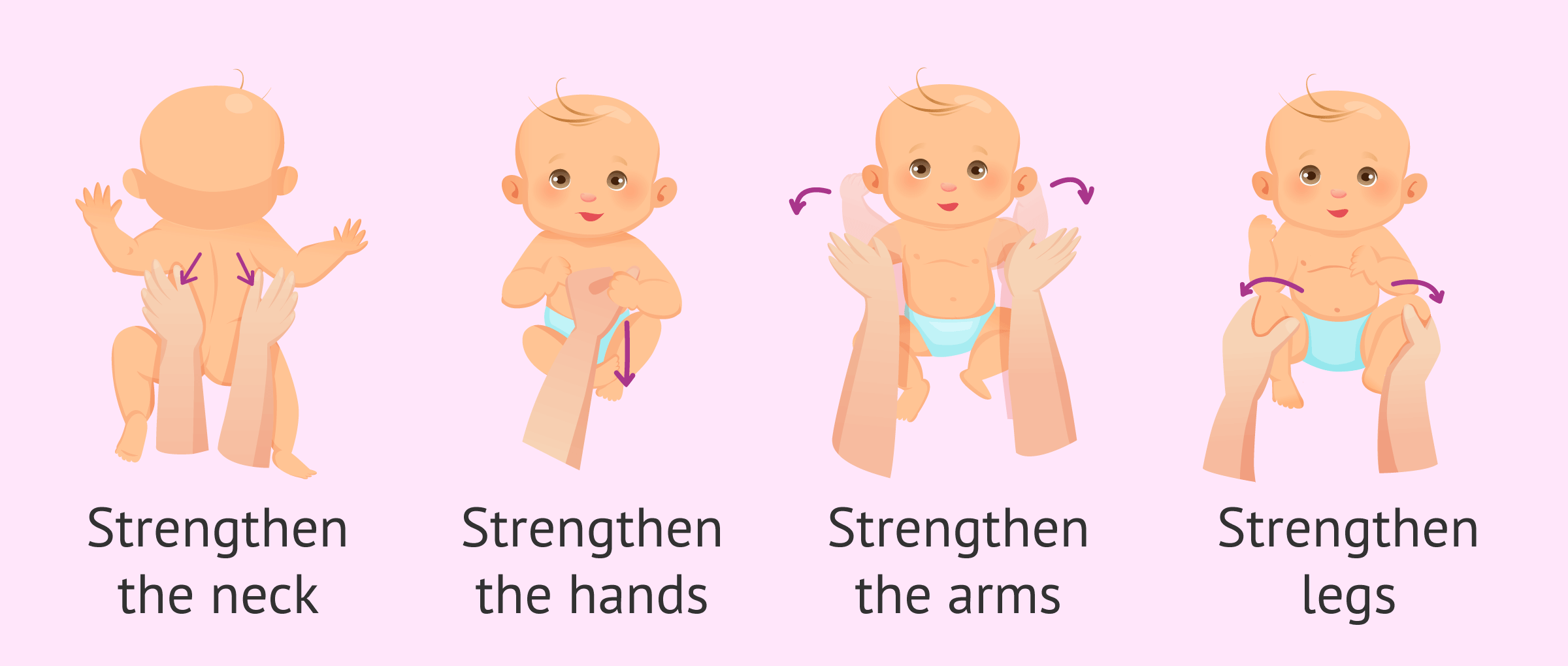
These exercises are very important in order to facilitate the baby's crawling in the near future. These are discussed below:
- Strengthening the neck
- lay the baby on his stomach and stroke his back from the nape of the neck to the lower back to straighten his head and trunk. It is also important to start holding him in an upright position so that he can support his own head.
- Strengthening hands
- lay the baby on its back, stroke its hands so that it tries to open them and take one of the mother's fingers. When the baby is able to latch on to the mother's finger, the mother should pull gently to lift the baby up a little so that he or she can hold on tighter.
- Strengthening the arms
- lay the baby on his back, take his little hands and extend his arms upwards, downwards, sideways and then cross them over his chest, all this with very gentle movements.
- Strengthening the legs
- the same gentle movements can be made as with the arms. You can also bend your knees, bring your legs towards your abdomen and extend them again. In addition, this last exercise will favor the baby's intestinal transit in case he/she is constipated.
It is important to do all activities with love and care, respecting the baby's sleeping and feeding hours.
Stimulation from 3 to 6 months
Babies grow very fast. At 3 months, they move their arms and legs vigorously, murmur and laugh in response to stimuli and can follow objects with their eyes.
The following exercises will serve to further stimulate his nervous and motor system, as he will soon be able to crawl and stand up:
- Put a toy on the baby's face so that he/she can try to pick it up on his/her own. You can also put the baby on his tummy and leave the toy a little bit away so that he can try to reach it.
- Play peek-a-boo with the baby: mom or dad will hide his or her face behind a book and surprise the baby by peeking out from above. The baby will laugh and will be mentally calculating when you are going to peek out again.
- If the baby is already sitting up, a person can stand in front of him and move him slightly from side to side by touching his shoulders. Faced with this imbalance, the baby will support himself with his hands to avoid falling and this will stimulate his reflexes.
- Place the baby in front of a mirror and move him/her to see his/her reflection in it.
- Move the rattle or a musical toy in his right ear and then in his left ear.
- Let the baby smell various scents every day, such as fruits, flowers, rose water, etc.
- Perform a trumpet on the baby's belly to tighten and untighten it.
- Sing a song to the baby while holding his hands so that he claps his hands.
- Lay the baby on his back, hold him by the forearms and slowly sit him up while saying "up". Watch that his head does not go backwards.
- Lay the baby face down, put your hand on the baby's stomach and gently raise and lower. The height must be increased little by little.

It is important to celebrate each achievement of the baby after each activity. To do this, you can lift the baby up by the armpits to face level, smile and say "very good."
FAQs from users
Which toys are the most suitable for baby's development?
Toys with lots of bright, flashy colors are best suited to stimulate baby's eyesight. These colors are red, blue, yellow, yellow, green, orange and hot pink. It is important to move these toys or objects in front of his face so that he can follow them with his eyes or place a mobile above the crib.
Toys with musical sounds are also good for stimulating the baby's hearing. The easiest thing for the baby to hold is a rattle.
What early stimulation exercises can be done during the baby's bath?
Bath time for babies is one of their favorite moments, since they have a lot of fun in the water and are very relaxed. Some recommendations to stimulate the baby while bathing are the following:
- Use a scented soap that foams.
- Place colorful floating toys in the water.
- Give a relaxing massage with cream all over the baby's body after bathing.
What are the best stimulation exercises for premature babies?
First of all, it is important to know the baby's corrected age, i.e. the number of months he/she would have been if he/she had been born on the due date and not before. In this way, it is possible to know the moment of development in which the baby is in order to start with the early stimulation.
Before carrying out the exercises discussed in this article, it is necessary to practice the following activities with premature babies:
- Infant massage: this consists of holding each of the parts of the baby's body with your hands without moving them, just so that the baby feels the contact and trying to transmit relaxation and tranquility.
- Therapeutic touch: this involves massaging and caressing the baby but without touching him, keeping a distance of about 5-10 cm.
- Place the baby naked on the mother's or father's chest, between the clothes and the bare skin, maintaining the maternal-filial bond. This promotes the production of breast milk and helps regulate the baby's temperature and heart and respiratory rate.
Suggested for you
After these first months of your baby's life, a new stage begins in which he or she will be much more active. You can continue reading about primary care in the following article: Early stimulation exercises from 6 to 12 months.
We make a great effort to provide you with the highest quality information.
🙏 Please share this article if you liked it. 💜💜 You help us continue!
References
Melinda B Clark-Gambelunghe, David A Clark. Sensory development. Pediatr Clin North Am. 2015 Apr;62(2):367-84. doi: 10.1016/j.pcl.2014.11.003 (View)
Ravi Prakash Upadhyay, Sunita Taneja, Tor A Strand, Halvor Sommerfelt, Mari Hysing, Sarmila Mazumder, Nita Bhandari Jose Martines, Tarun Dua, Patricia Kariger, Rajiv Bahl. Early child stimulation, linear growth and neurodevelopment in low birth weight infants. BMC Pediatr. 2022 Oct 8;22(1):586 (View)
Sanne L C Veldman, Rute Santos, Rachel A Jones, Eduarda Sousa-Sá, Anthony D Okely. Associations between gross motor skills and cognitive development in toddlers. Early Hum Dev. 2019 May:132:39-44. doi: 10.1016/j.earlhumdev.2019.04.005. Epub 2019 Apr 6 (View)