
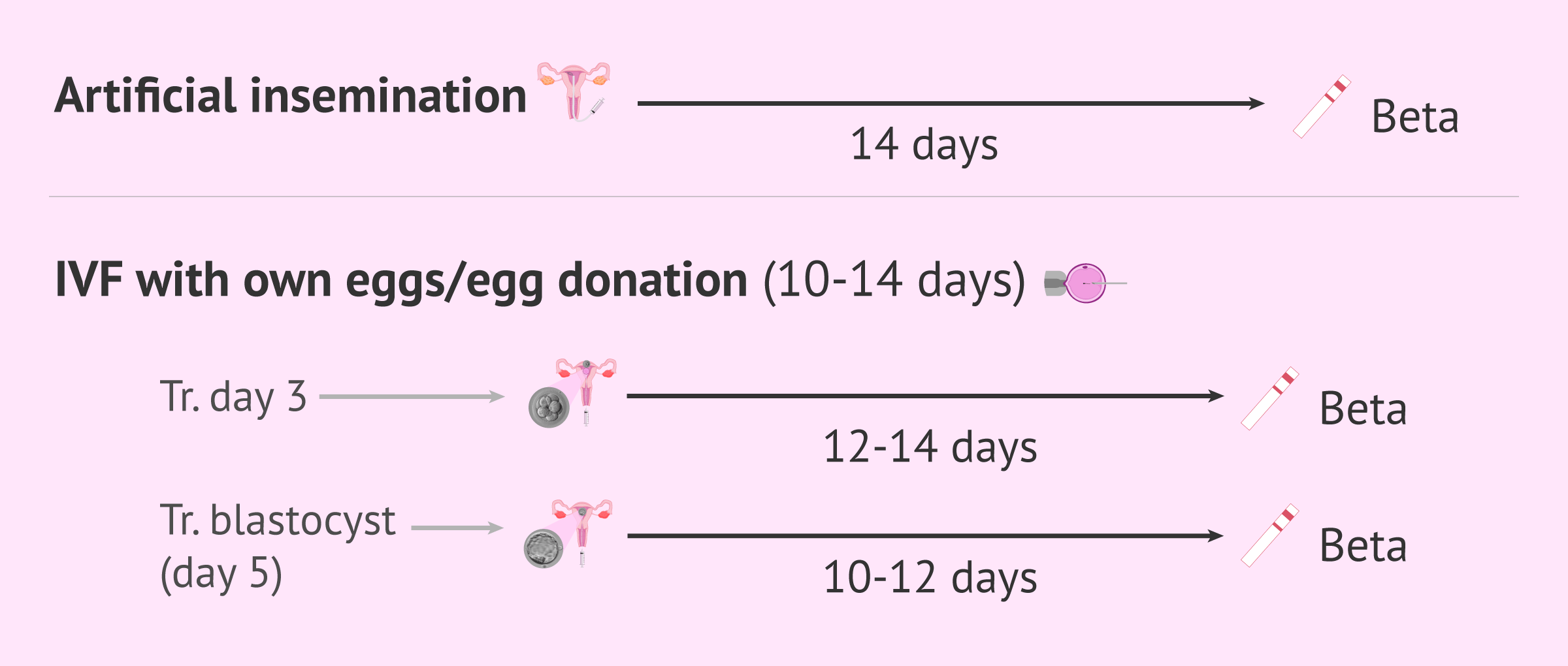
Not exactly. Although as a general rule it is recommended to wait a period of 10 to 14 days to take a pregnancy test, the ideal time to perform the blood test varies slightly depending on the assisted reproduction technique performed and the stage of development of the embryo:
- Two-week wait in artificial insemination: in this fertility treatment, fertilization of the egg occurs naturally inside the fallopian tubes after the semen sample is introduced into the uterus. Since we do not know the exact day the embryo will manage to implant, a mandatory 14-day wait is required from the moment of insemination to ensure that hCG hormone levels in the blood are stable enough, thereby avoiding an erroneous result.
- Two-week wait after In Vitro Fertilization (IVF) or Egg Donation: in IVF cycles (whether with own eggs or through egg donation), the transfer is performed with embryos that have already been developing in the laboratory for several days. This allows us to better adjust the timeline. If transferred on day 3 of development, the embryo must spend an additional 2 to 3 days dividing in the uterus before implanting. For this reason, the wait is usually set between 12 and 14 days post-transfer. On the other hand, if day 5 blastocysts are transferred, the waiting period can be safely shortened, with the blood test being scheduled between 10 and 12 days after the transfer.
Read the full article on: What is the two-week wait? – Symptoms and tips after treatment ( 84).

Marta Barranquero Gómez
B.Sc., M.Sc.
Graduated in Biochemistry and Biomedical Sciences by the University of Valencia (UV) and specialized in Assisted Reproduction by the University of Alcalá de Henares (UAH) in collaboration with Ginefiv and in Clinical Genetics by the University of Alcalá de Henares (UAH).
License: 3316-CV

