
Retinitis pigmentosa is the hereditary degeneration of the cones and rods in the retina, which leads to blindness. This disease has various inheritance patterns.
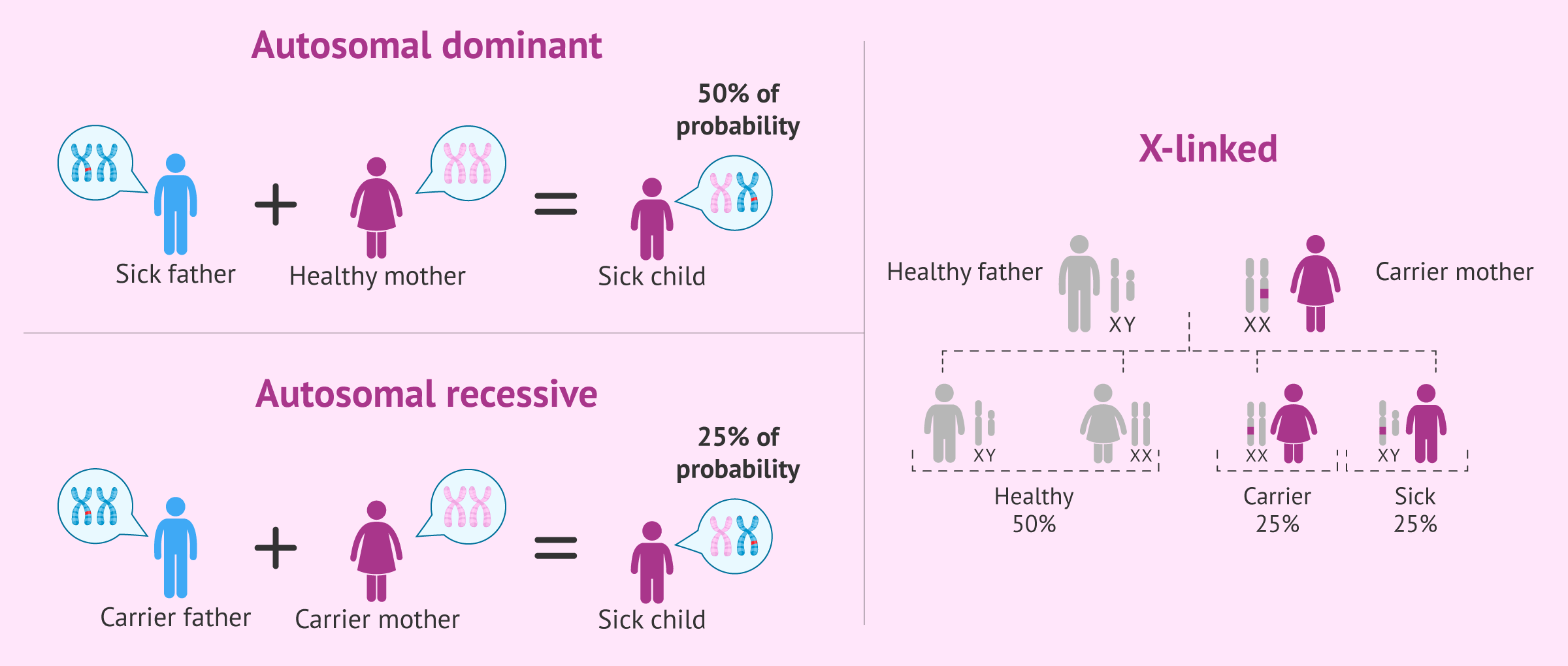
One of them is autosomal dominant, meaning that in a couple where one parent has the disease, there is a 50% chance of having a child with retinitis pigmentosa. In contrast, if the inheritance pattern is autosomal recessive, the probability of having a child with the disease is reduced to 25%.
Another possible inheritance pattern for retinitis pigmentosa is X-linked. In this case, if the mother is a carrier of the mutation causing retinitis pigmentosa, there is a 50% chance of having affected sons. However, all daughters will be healthy, although 50% of them will be carriers.
Read the full article on: Can retinitis pigmentosa be prevented from being passed on to children? ( 55).
By Marta Barranquero Gómez B.Sc., M.Sc. (embryologist).
Last Update: 09/08/2025

