
Artificial intelligence (AI) has become a transformative force in the healthcare field, and its integration into the field of assisted reproduction represents a notable milestone. The use of this technology seeks to respond to the constant challenge of optimizing results and improving success rates in clinics.
A recent review study has analyzed in depth how AI can revolutionize these treatments. This research was developed by the authors Pragati Kakkar, Shruti Gupta, Kasmiria Ioanna Paschopoulou, Ilias Paschopoulos, Ioannis Paschopoulos, Vassiliki Siafaka and Orestis Tsonis.
These experts belong to the following institutions: Guy's Hospital (Guy's and St Thomas NHS Foundation Trust, United Kingdom), University of Ioannina (Greece), National Technical University of Athens (Greece) and National and Kapodistrian University of Athens (Greece).
Provided below is an index with the 8 points we are going to expand on in this article.
Sperm analysis with artificial intelligence
Regarding sperm analysis, the technology provided by artificial intelligence helps to evaluate the semen sample more quickly and accurately:
- New algorithms allow analyzing sperm motility and viability automatically.
- The use of AI helps to reduce human error during evaluation.
- There are already advances that include the use of smartphones to calculate sperm concentration in an automated way.
The incorporation of these tools not only improves laboratory efficiency but also provides greater objectivity before proceeding with egg fertilization.
Improvement in egg selection using AI
The egg plays a fundamental role in the development of the future embryo, so its correct selection is a critical step.
- Artificial intelligence models can predict the potential an egg has to be fertilized based on its morphological characteristics.
- Furthermore, they have shown an 86% accuracy when predicting this fertilization potential and subsequent embryonic development.
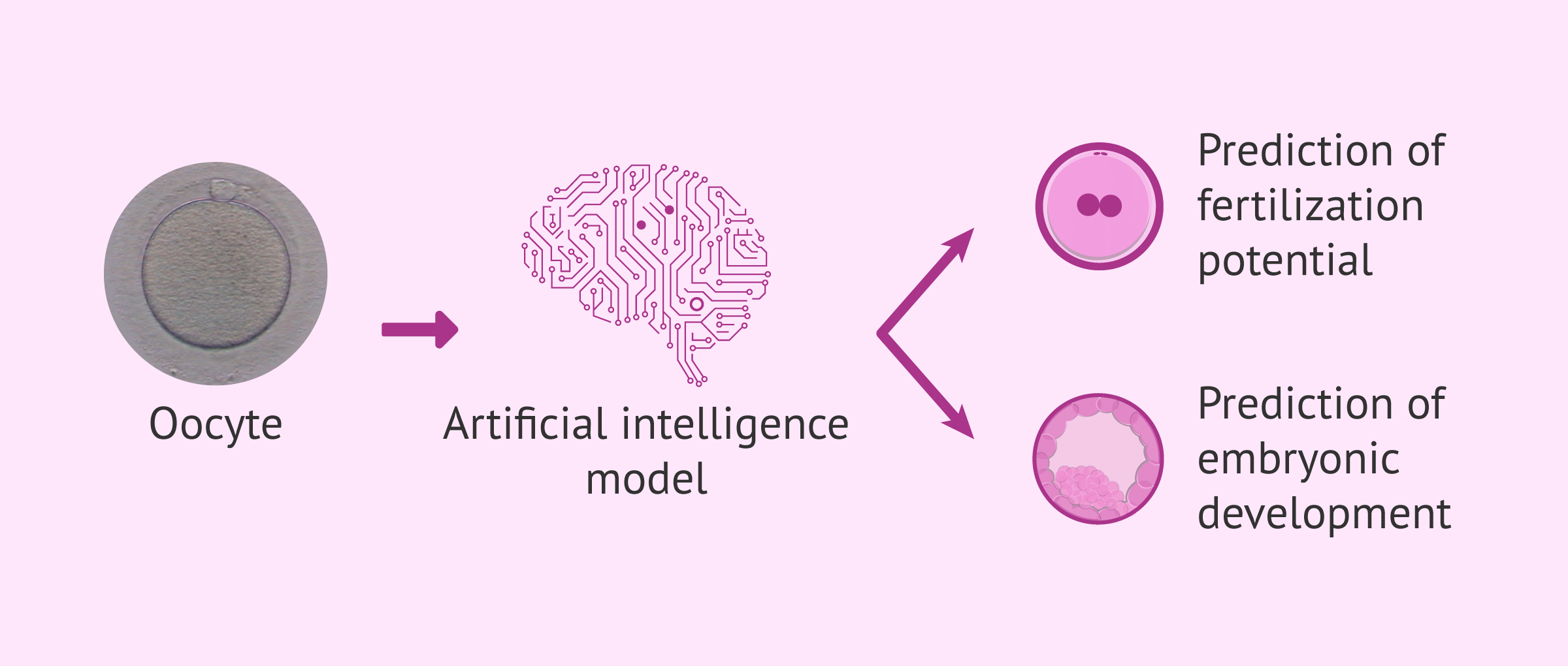
Thanks to these advances, the embryology team has fundamental support to select eggs with the highest probability of success.
Advances with AI to choose the best embryo
Given that single embryo transfer has become standard practice, being able to accurately classify embryos and choose those with the greatest potential for success is of vital importance.
- Artificial intelligence algorithms are capable of differentiating between correct fertilization and an anomalous one.
- Artificial intelligence models also have the potential to predict which embryos will successfully reach the blastocyst stage.
- They also help distinguish between embryos that have normal genetics (euploid) and those with alterations (aneuploid). The sensitivity to predict genetically normal embryos ranges between 75% and 95%, depending on the data used.
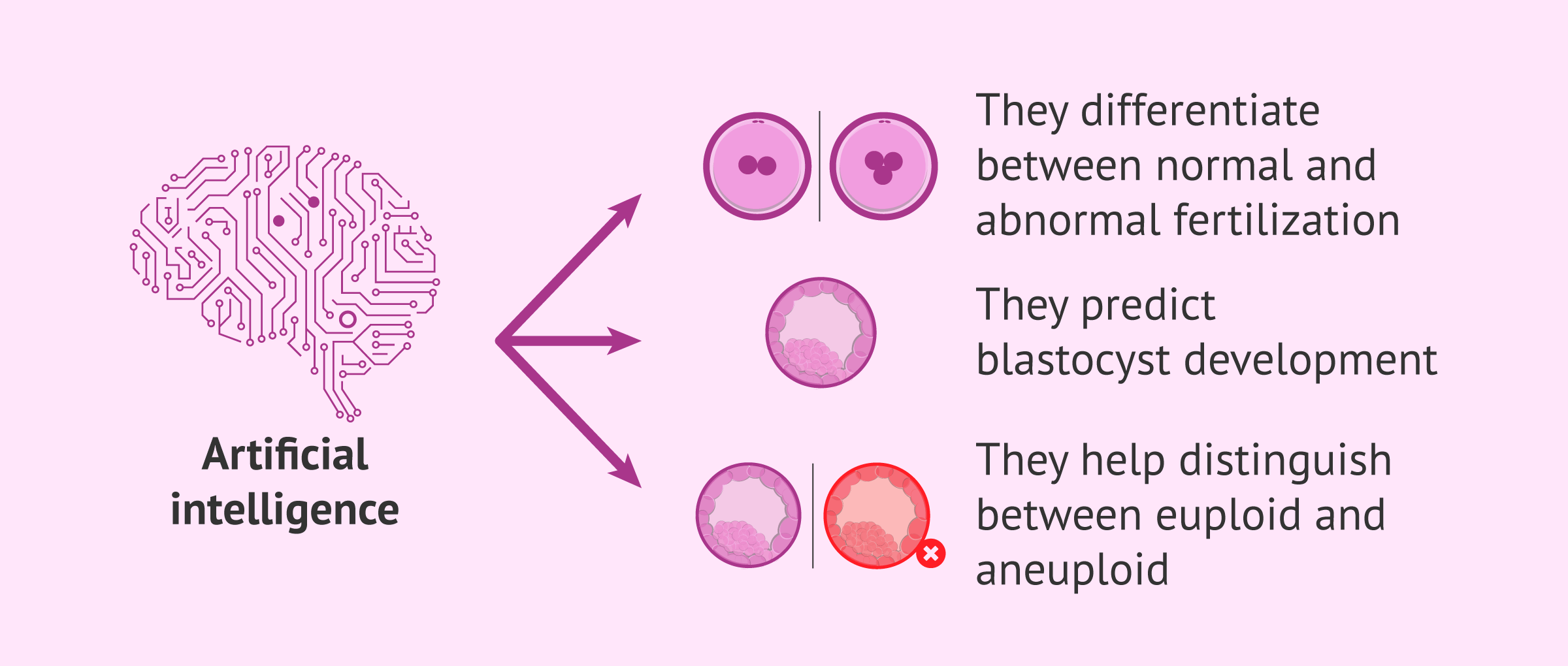
In this way, artificial intelligence allows making a better decision when deciding which embryo is best to transfer.
AI would allow for more personalized treatments
Precision medicine (which uses information about a person's genes, proteins, environment, and lifestyle habits) and artificial intelligence come together to create tailor-made strategies for each patient's particular situation. AI-based diagnostic tools integrate a vast amount of data to be more precise:
- They develop personalized treatment plans that take into account medical history, genetics, and responses to previous treatments.
- They minimize the "trial and error" method when selecting medication.
- They allow monitoring and adjusting treatment plans in real time.
All this contributes to improving overall patient care and increasing the chances of achieving an ongoing pregnancy.
Challenges and ethics in its application
Despite its great potential, the rapid integration of artificial intelligence into healthcare brings ethical and legal challenges that require attention:
- It is essential to guarantee the privacy and security of sensitive data of patients.
- Bias in algorithms must be avoided so that there are no inequalities in treatments.
- Decisions made by AI must be transparent and understandable.
- Currently, there is a demand for specific and strict regulation on a global scale to ensure ethical and responsible use of AI in healthcare.

The joint effort between AI developers and medical professionals will be the key to ensuring these technologies are reliable, transparent, and patient-centered.
Community and Support
At inviTRA we work to make monthly and rigorous information accessible to everyone. If this article has helped you, consider supporting us so we can continue accompanying more people on their journey to parenthood.
References
Kakkar P, Gupta S, Paschopoulou KI, Paschopoulos I, Paschopoulos I, Siafaka V, Tsonis O. The integration of artificial intelligence in assisted reproduction: a comprehensive review. Front Reprod Health. 2025 Mar 20;7:1520919. doi: 10.3389/frph.2025.1520919. PMID: 40182958; PMCID: PMC11965653. (View)


