When and how to start weaning a baby from diapers?
The time to definitively remove the baby's diaper often generates some doubts in parents, as to whether their little one is ready for it and how to do it in a respectful way with their baby.
The truth is that there is no specific age that is the most appropriate for the baby to leave the diaper, but that he will leave it when he is ready. Keep in mind that every baby is different. Just as all babies do not teething at the same time or start talking at the same time, not all babies are toilet trained at the same age.
The different sections of this article have been assembled into the following table of contents.
Contents
- 1.
- 1.1.
- 2.
- 3.
- 4.
- 4.1.
- 4.2.
- 5.
When to start removing the baby's diaper?
It is often said that the right age to begin to remove the diaper from the baby is between 2 and 3 years old, and the truth is that 95% of the little ones have achieved it by the age of 3 and a half years old. However, the right time to stop diapering does not depend so much on a specific age, but on the baby's maturity stage.
Each baby has his own developmental pace and toilet training is a milestone that he will reach when he is ready for it.
How do you know if your baby is ready to give up diapers?
When many parents ask themselves if their baby is ready to give up diapers, the answer will be given by their own baby through certain signs that parents will observe. Among these signs that herald that it may be a good time to stop diapering are:
- He is able to keep his diaper clean for 2-3 hours, so it is now necessary to change it less frequently. This is one of the most important signs, since it is evidence that the baby is already beginning to be able to control its sphincters.
- Starts to be uncomfortable with the diaper, may try to take it off and tells when it is dirty or wet to have it changed.
- He does certain things on his own and can now pull his pants up and down without help.
- He goes to the bathroom when his parents or older siblings (if any) do, is curious about what is being done there, and even wants to flush the toilet. In addition, it is an ideal time to explain to him and he can learn certain very useful things as "training" to leave the diaper: what is pee, what is poop, what is done in the toilet .... It is important that the child learns these concepts and knows what is done in the bathroom.

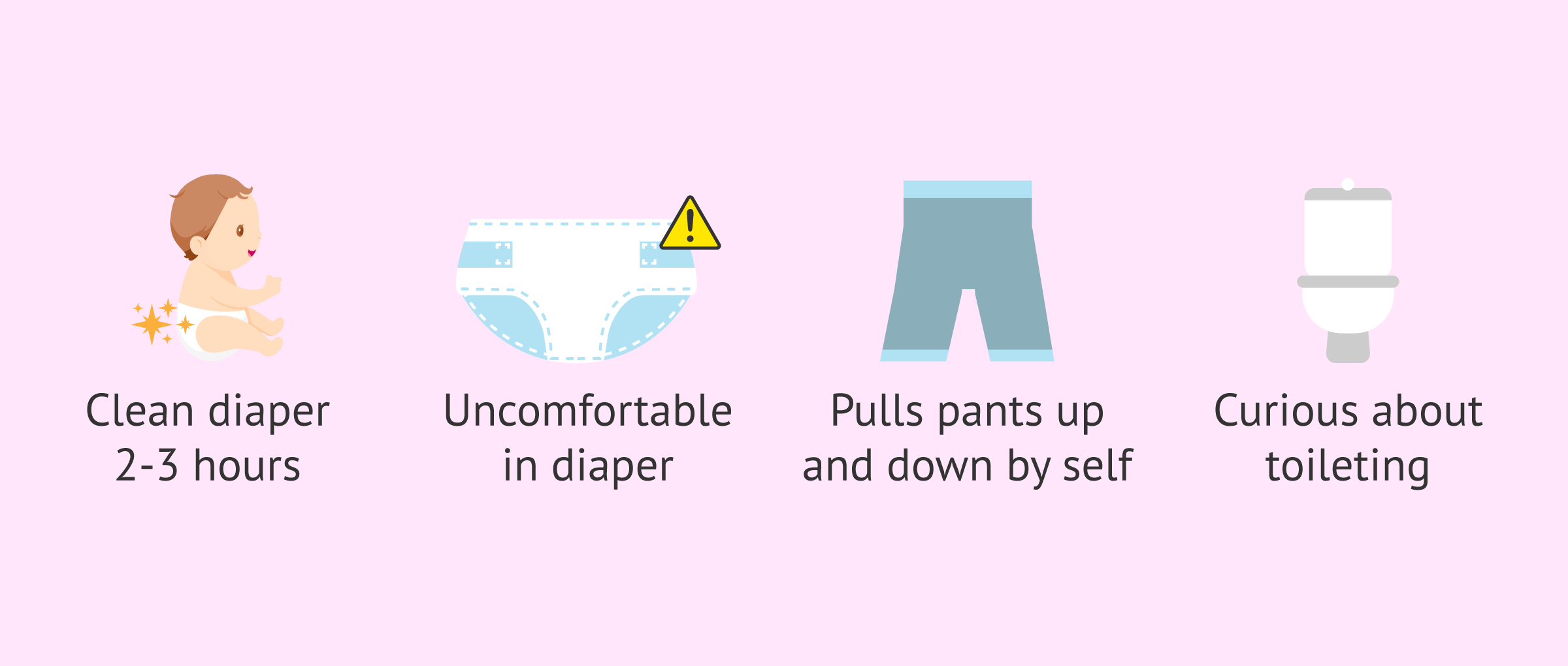
When all (or almost all) of these signs are present, your baby is probably ready to start peeing in the potty. However, it is true that some parents decide to wait until summer to try to get their baby out of diapers. The reasons are that during the vacations there is more free time to dedicate to this task and that it will be easier to change the child if there is any leakage, since we wear fewer clothes. In addition, the baby will not get cold during the changes.
How do you go about the process of weaning your baby from diapers?
First of all, in order to start the process of weaning the baby, it is essential to have detected that the baby is ready for it. Subsequently, it is necessary to be patient and avoid rushing, respecting the pace set by the child. Some recommendations for changing from diaper to underwear are as follows:
- Take advantage of the time when they go to the bathroom with their parents or older siblings to explain certain things and concepts related to the process of going to the bathroom.
- Motivate them and give them control in the process. They can choose their own potty and new underwear to wear to encourage them to start using it.
- Remove the diaper during the day, but keep it on even at night, since it is usually more difficult for them and it is not convenient to do it at the same time.
- Try, without forcing (they should sit on their own), to make them sit on the potty for a few minutes every 2 or 3 hours. This is especially important after each meal, before going to bed and before leaving the house.
- Detect when they may be peeing or pooping and encourage and accompany them to go to the potty to try to do it there. They may also be asked on occasion if they have the urge to go pee or poop.
- Congratulate them when they succeed, but without exaggerating, giving normality.
- Do not scold or punish when there is an escape. These accidents are part of his learning process, as they will teach him what happens when he does not go to the potty. The best thing to do is to simply tell him that next time you will try.
- Wait several days and, if no progress is seen, return to the diaper and wait until he/she is more ready.

Some children will not want to pee and poop in the potty, but will be more attracted to doing it in the toilet like their parents do. This is a normal occurrence, but a toilet adaptor and a small step should be used to allow him to climb up and support his feet.
Recommendations for weaning your baby from diapers
Some of the basic recommendations when it is time for the child to stop wearing a diaper are the following:
- Wait until the baby is ready. Starting too early can cause frustration for parents and the child.
- Be patient, show understanding.
- Reading children's stories related to this process can be of great help.
- Use clothing that is easy to put on and take off.
- Do not force them to sit on the potty and pee at a certain time if they do not feel like it.
- Do not scold him when there is an escape, it is usual and is part of the process.
- Encourage them and value their effort when they do it correctly.
- Bring a change of clothes when leaving home.

In addition, it is important to understand that there may be some backward steps at times of stress for the child (the start of school, the arrival of a sibling, the transition from crib to bed...). Likewise, it is important to avoid starting the process at this time of change.
FAQs from users
How to remove the baby's diaper at night?
It is recommended that the child first stops diapering during the day and begins to relieve himself on the potty (or on the toilet with an adapter), keeping the diaper on during the night.
The time to remove the diaper at night will come when your little one wakes up with a clean diaper for several days, because he wakes up or lets you know when he has the urge to go to the bathroom during the night. It will be easier if he always goes to the bathroom before going to sleep.
However, it is important to know that up to the age of 5-6 years there may be some leaks and they may wet the bed, without this being a cause for concern, as it is considered normal. It is therefore advisable to use a waterproof mattress cover.
Can a diaper be removed from an 18-month-old baby?
The time at which a baby stops wearing a diaper does not depend so much on age, but on maturity. It is often said that babies stop wearing a diaper between 2-3 years of age and it is true that many of them will achieve this between these ages.
However, you should not begin the process of weaning your baby if he or she is not ready for it. Some indicators that the baby may be ready to be weaned are: he/she keeps the diaper clean for 2-3 hours, the diaper begins to bother him/her and asks to be changed when it is dirty and wet, he/she can pull his/her pants up and down by him/herself, and he/she is curious and goes to the bathroom with the parents.
We make a great effort to provide you with the highest quality information.
🙏 Please share this article if you liked it. 💜💜 You help us continue!
References
Baird DC, Bybel M, Kowalski AW. Toilet Training: Common Questions and Answers. Am Fam Physician. 2019 Oct 15;100(8):468-474. PMID: 31613577. (View)
Carvalho TA, Vasconcelos MMA, Guimarães ICO, Dutra MF, Lima EM, Bastos Netto JM, de Bessa Junior J, Simões E Silva AC, de Carvalho Mrad FC. Relationship between toilet training process and primary nocturnal enuresis in children and adolescents - A systematic review. J Pediatr Urol. 2022 Oct;18(5):554-562. doi: 10.1016/j.jpurol.2022.07.033. Epub 2022 Aug 10. PMID: 35987679. (View)
de Carvalho Mrad FC, da Silva ME, Moreira Lima E, Bessa AL, de Bessa Junior J, Netto JMB, de Almeida Vasconcelos MM. Toilet training methods in children with normal neuropsychomotor development: A systematic review. J Pediatr Urol. 2021 Oct;17(5):635-643. doi: 10.1016/j.jpurol.2021.05.010. Epub 2021 May 13. PMID: 34090792. (View)
Toilet Training. Am Fam Physician. 2019 Oct 15;100(8):Online. PMID: 31613579. (View)
van Nunen K, Kaerts N, Wyndaele JJ, Vermandel A, Hal GV. Parents' views on toilet training (TT): A quantitative study to identify the beliefs and attitudes of parents concerning TT. J Child Health Care. 2015 Jun;19(2):265-74. doi: 10.1177/1367493513508232. Epub 2013 Nov 21. PMID: 24270991. (View)