
The decision to freeze eggs to preserve fertility is increasingly common, but one of the great unknowns has always been knowing how many eggs are necessary to try to obtain a pregnancy in the future.
A recent study has analyzed this question by combining maternal age and evaluation through artificial intelligence (AI). The research was carried out by the authors Daniela P.A.F. Braga, Amanda S. Setti, Maite Del Collado, Jullin Fjeldstad, Parisa Mojiri, Melissa Cavagnoli and Edson Borges Jr., and included the participation of the Centro de Estudos em Reprodução Assistida del Instituto Sapientiae, Equinvitro Research and Development in Reproduction, Future Fertility, Hope Clinic and Fertility/FERTGROUP-Medicina Reprodutiva.
Provided below is an index with the 6 points we are going to expand on in this article.
Vitrifying eggs: AI and maternal age
Until now, the woman's age is a key piece in clinical counseling for vitrifying eggs. However, this new approach introduces an artificial intelligence (AI) system that analyzes images of the eggs and assigns them a quality score from 0 to 10.
To calculate the optimal number, the researchers crossed this visual oocyte quality obtained by AI with two determining factors:
- The ability to reach the blastocyst stage (5-day embryo).
- The probability that this embryo is genetically normal (euploid), something that decreases over the years.
By integrating all the data, the model was able to estimate the minimum amount of mature oocytes a person would need to freeze to obtain, with high probability, at least three healthy (euploid) embryos, since this is considered a threshold linked to a good cumulative probability of pregnancy in the future (although other factors also intervene).
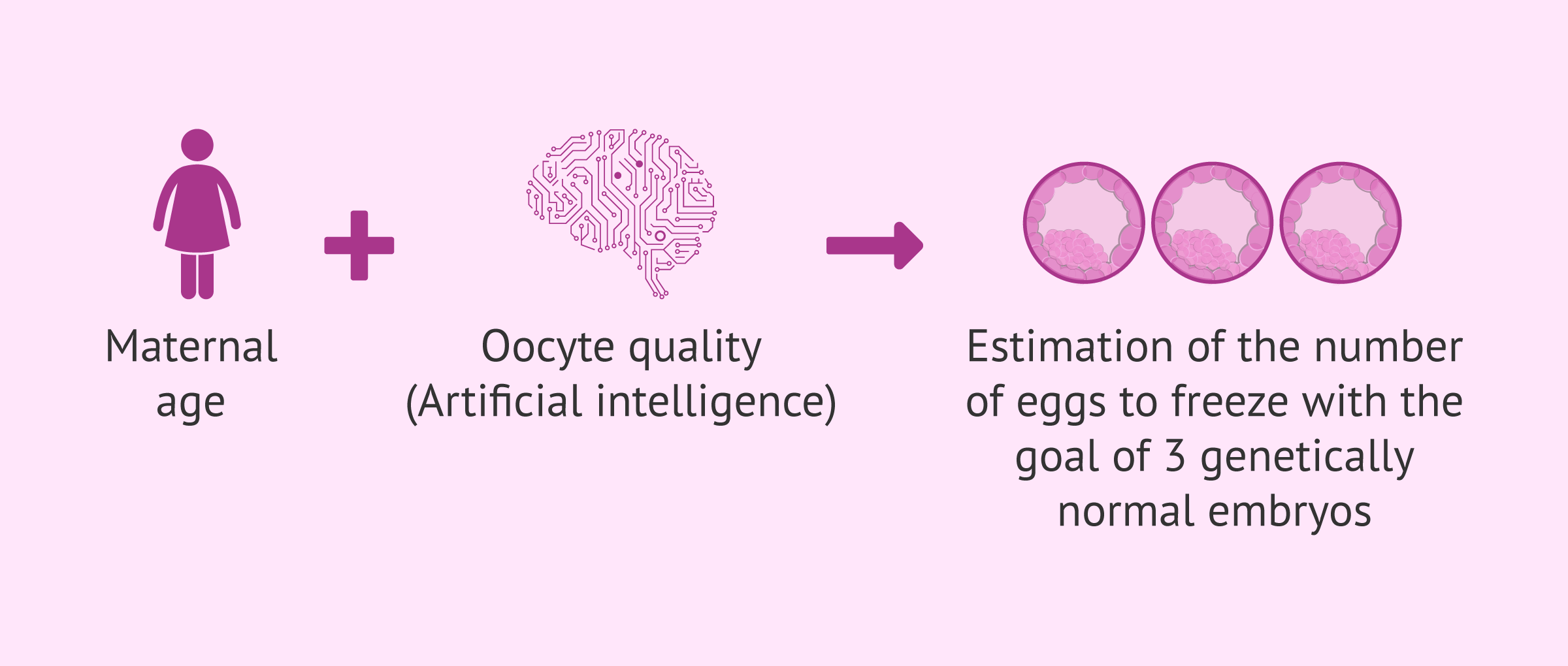
The use of these technological tools represents a great advance, as it allows putting aside general recommendations to offer each person a completely personalized fertility preservation plan.
Eggs needed for success
The study's results reveal that the amount of eggs needed increases as age advances and the oocyte quality detected by AI decreases. The estimates show marked contrasts depending on each case's profile:
- Women under 30 years old with high quality eggs: would need to freeze around 9 eggs.
- Women between 34 and 36 years old with intermediate quality: would require vitrifying about 18 eggs.
- Women over 40 years old with low quality: the figure would rise to 121 eggs.
These exact results do not necessarily have to be the same in all fertility centers. However, the way and strength with which age and the artificial intelligence program influence (that is, whether they increase or reduce the number and in what proportion) would be more generalizable.
The impact of oocyte quality
One of the most revealing findings of the research is the huge gap that exists between the number of oocytes patients manage to freeze in a single ovarian stimulation cycle and what they would need according to this model, especially at advanced ages.
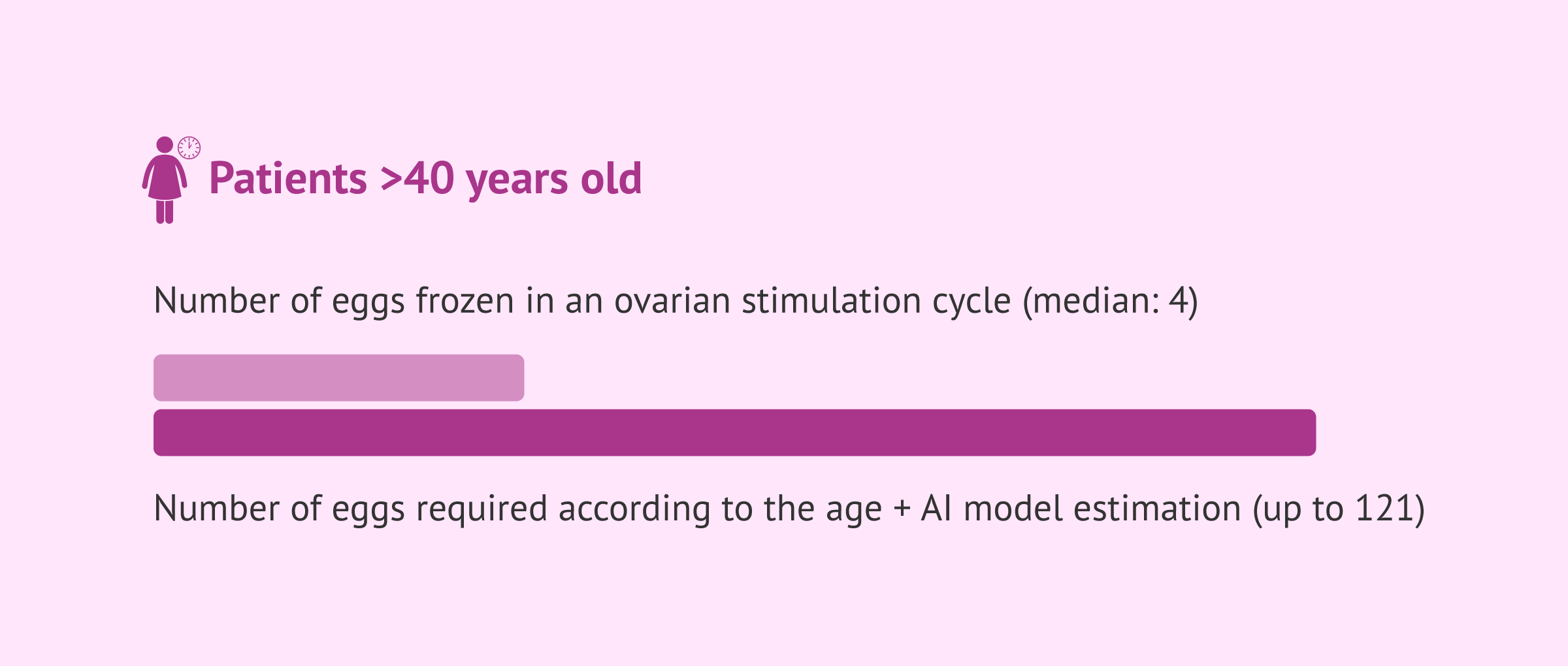
This huge difference indicates that a single ovarian stimulation cycle is rarely sufficient for women who decide to preserve their fertility at an advanced maternal age, with all that this implies in terms of costs, time, and emotional burden.
Thanks to these predictive models, specialists can establish much more realistic expectations and help plan if several oocyte retrieval cycles will be necessary to achieve the desired goal.
Community and Support
At inviTRA we work to make monthly and rigorous information accessible to everyone. If this article has helped you, consider supporting us so we can continue accompanying more people on their journey to parenthood.
References
Braga DPAF, Setti AS, Del Collado M, Fjeldstad J, Mojiri P, Cavagnoli M, Borges E Jr. Are women cryopreserving enough oocytes for fertility preservation? A probabilistic model integrating AI-based oocyte morphology and age-dependent euploidy. Hum Reprod Open. 2026 Oct 14;2026(4):hoag090. doi: 10.1093/hropen/hoag090. PMID: 42924271; PMCID: PMC13690086. (View)
Author

Find the latest news on assisted reproduction in our channels.

