
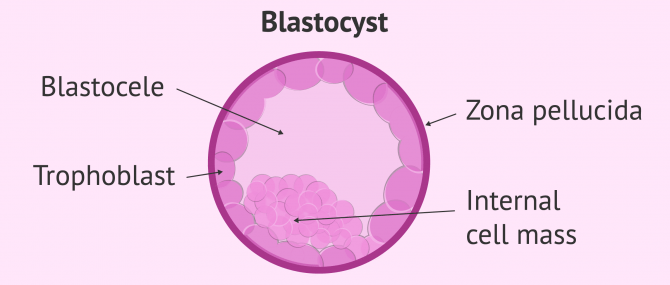
A blastocyst is an embryo that has reached the 5th day of development. At this time, its structure is made up of a multitude of cells that have already begun to form a specialization and, therefore, it is possible to distinguish several parts of a blastocyst:
- The trofoectoderm
- are the cells that come in contact with the endometrium and, subsequently, will originate the placenta.
- The internal cell mass (ICM)
- is inside the trofoectoderm and is the structure that will give rise to the fetus.
- The blastocele
- is the central cavity of the embryo that is filled with fluid.
- The zona pellucida
- is a protective layer that surrounds the blastocyst until hatching occurs and the blastocyst detaches from it in order to implant.
Community and Support
At inviTRA we work to make monthly and rigorous information accessible to everyone. If this article has helped you, consider supporting us so we can continue accompanying more people on their journey to parenthood.
Author

Graduated in Biochemistry and Biomedical Sciences by the University of Valencia (UV) and specialized in Assisted Reproduction by the University of Alcalá de Henares (UAH) in collaboration with Ginefiv and in Clinical Genetics by the University of Alcalá de Henares (UAH). More information about Marta Barranquero Gómez
License: 3316-CV
Find the latest news on assisted reproduction in our channels.

