
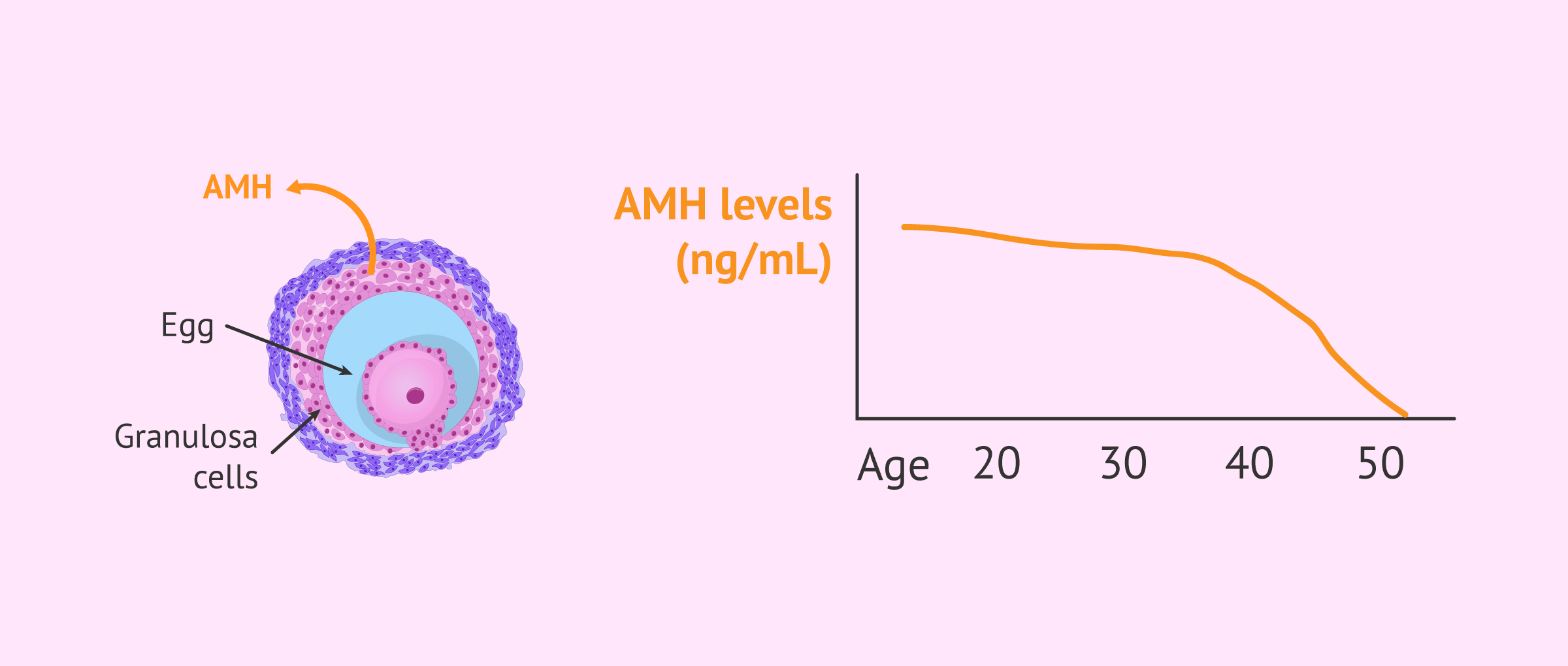
Anti-Müllerian hormone (AMH) is produced by the granulosa cells of developing ovarian follicles. For this reason, AMH levels provide information about the number of growing ovarian follicles.
As women age, the number of ovarian follicles decreases, and consequently, so do their AMH levels.
Read the full article on: Ovarian reserve tests: What they are and how to interpret them ( 66).
By Andrea Rodrigo B.Sc., M.Sc. (embryologist), Guillermo Quea Campos M.D. (gynecologist), Javier Liñayo Chouza M. D. (gynecologist), José María Sánchez Jordán M.D. (gynecologist), Mark P. Trolice M.D., F.A.C.O.G., F.A.C.S., F.A.C.E. (reproductive endocrinologist), Paloma Sánchez Gómez M. D. (gynecologist), Silvia Azaña Gutiérrez B.Sc., M.Sc. (embryologist) and Michelle Lorraine Embleton B.Sc. Ph.D. (biochemist).
Last Update: 06/25/2026

