Ovoclinic Marbella


The different sections of this article have been assembled into the following table of contents.
Contents
- 1.
- 2.
- 3.
- 3.1.
- 4.
- 4.1.
- 4.2.
- 4.3.
- 4.4.
- 4.5.
- 4.6.
- 4.7.
- 4.8.
- 5.
- 6.
- 7.
- 8.
- 9.
- 9.1.
- 10.
Description
Ovoclinic Marbella is a private fertility clinic located in the center of Marbella (Spain), with a total of 1,054m2.
Its founder and director is embryologist Enrique Criado Scholz, its medical director is Dr. Daniel Sosa and in total, they form a team of 150 professionals among doctors, laboratory staff, nurses, coordinators, etc.
Ovoclinic Marbella has the capacity to perform about 1,200 cycles of assisted reproduction per year and 50% of its patients are foreigners. For this reason, the clinic has an international department and is able to attend patients in English, French, Italian, Portuguese, and Arabic.
If you need information on how to get to the Ovoclinic Marbella clinic, either by public or private transport, you can access this link.
History
Ovoclinic Marbella opened its doors in 2012, originally under the name FIV Marbella. Today, Ovoclinic Marbella has four centers in different Spanish cities: Marbella, Seville, Madrid, and Ceuta.
In terms of awards which Ovoclinic Marbella received during the last years, the following are the most important ones:
- Andalusia Excellence Award 2018, medical category
- National Medicine Award 2018, assisted reproduction category
- National Medicine Award 2019, assisted reproduction category
- A Tu Salud 2019 Award, reproductive medicine and fertility category
- Isaac Peral 2021 National Award for Research, Science and Innovation, granted by the European Association of Economy and Competitiveness (AEDEEC).
- European Awards in Medicine 2023.
What treatments do they perform?
The treatments that can be carried out at Ovoclinic Marbella are specified below:
Ovoclinic offers guarantee programs whereby if you do not achieve pregnancy, you will receive a refund, as well as a birth guarantee for in vitro fertilization treatments. This option, with unlimited attempts, provides security and confidence in the process for patients seeking to become pregnant.
If you're still unsure which fertility treatment is right for you and would like to know more about it, we suggest you read on here: Fertility Treatment Overview.
The treatment costs may vary significantly depending on the tests or techniques included or not, such as the seminogram, medication, fertility testing, medical visits, prolonged culture or embryo vitrification.
This Tool helps you to find out the exact costs of the different fertility clinics (what's included and what's not) and provides you with lots of useful tips for your first appointment.
Complementary techniques
In addition to all the treatments indicated in the previous section, Ovoclinic Marbella also offers its patients other complementary techniques.
The blastocyst culture, for example, has the advantage of better selecting the embryos with the greatest potential for implantation and thus increasing the probability of pregnancy. It is especially indicated for couples with implantation failures or miscarriages.
In addition, Ovoclinic Marbella has a state-of-the-art incubator, the EmbryoScope. This tool allows the development of embryos to be observed on a monitor in real time and without interruption, providing a significant advantage when selecting the best embryo.
Men who suffer from azoospermia, on the other hand, can undergo sperm retrieval techniques such as testicular biopsy or epididymal aspiration.
Other complementary techniques performed at Ovoclinic Marbella are Assisted Hatching, ICSI, Genetic Compatibility Test, etc.
Facilities
Ovoclinic Marbella was renovated in 2018, so all its facilities are very new and modern, adapted to all the needs that fertility patients may have.
In the following section, you’ll find a list of all the areas of the clinic, with the resources and technology available to carry out fertility treatments.
Building and facade
Ovoclinic Marbella occupies the first floor of an 8-story corner building located very close to the sea.
The entire façade is designed with large windows through which natural light enters the consultation and waiting room areas, although they have curtains covering them at all times for greater privacy.

The entrance door is also made of glass and opens automatically, thus adapted for people with reduced mobility.
Generally speaking, this is a very busy area, although you can easily park in an esplanade right on the side of the clinic.
Reception and waiting rooms
The reception of Ovoclinic Marbella is at the entrance and has two white counters in a modern style, one on the right and one on the left.
A total of 5 people work here and attend in different languages: Spanish, English, French and Italian.
Following the reception, there are 5 individual waiting rooms: four are small and one larger is the family room.
Each has a Nespresso coffee or tea machine, as well as magazines and newspapers for entertainment. One of the waiting rooms also has a television.
Apart from this, Ovoclinic Marbella has a specific waiting room for gamete donors. This one is bigger than the previous ones, as it is common, and has two sofas, six chairs, a table with magazines and a water dispenser.


Consultation rooms
The consultation area is located on the left side of the clinic, following the long corridor past the reception.
Ovoclinic Marbella has 5 medical consultations and 3 of them are with an examination room. It is located in a separate room inside the practice and is equipped with a gynecological table, the GE Healthcare ultrasound machine, and a hand washbasin.
A total of 4 gynecologists work at Ovoclinic Marbella who speak Spanish, English, French and Italian. The Italian-speaking gynecologist is a native.
All of them are on duty on weekends and holidays, both to perform the follicular puncture or embryo transfer when it is more convenient, and to perform ultrasound controls during the stimulation.
Operating Room
The IVF surgery room in Ovoclinic Marbella is 24.522 and is directly communicated with the IVF laboratory.
Before entering, there is the surgical area, which is a corridor where there are a sink and different access doors to other rooms, such as the laboratory or the recovery room. All these doors are automatic.
The operating room is large and fully equipped with everything needed to perform follicular puncture procedures, embryo transfer and major outpatient surgery: operating table, instrument tables, a monitor, an ultrasound machine, anesthesia administration system, defibrillator and crash cart.
In addition, this operating room has all the necessary measures to ensure maximum sterility conditions, such as the epoxy paper on the walls, and rounded corners and floor bases to prevent dirt from accumulating.
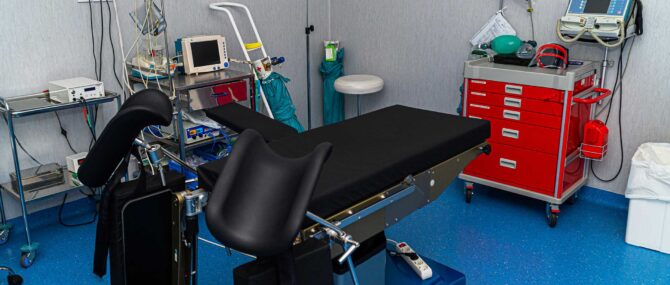
The staff that is present at the interventions are the gynecologist, the anesthesiologist, the nurse, the assistant, and the embryologist if necessary.
Laboratories
Ovoclinic Marbella has 3 physically separate laboratories: andrology, embryology, and a scientific laboratory. The latter two are divided by a glass wall and communicate through a window.

A total of 5 embryologists and 2 laboratory technicians work here, who are on duty on weekends.
Below, we will discuss each of them:
Andrology Laboratory
This laboratory has the necessary equipment and material to process the seminal samples: two laminar flow hoods, two-phase contrast microscopes, a working incubator, a centrifuge and a computer.
The procedures that are performed are the following:
- Semen Analysis.
- Sperm capacitation for artificial insemination.
- Sperm selection with MACS.
- Fragmentation test with Fertile® chip.
- Sperm selection with hyaluronic acid (SpermSlow™ PICSI).
- Sperm freezing.
This laboratory is also adapted to treat infectious sperm samples. However, all HIV-positive patients in Andalusia are referred to the Virgen de las Nieves Hospital in Granada for fertility treatment.
IVF Laboratory
The doors of the IVF laboratory are automatic and access is restricted from the surgical site.
Here we find all the technology and materials necessary for the correct handling of biological samples: two laminar flow hoods with heated surfaces, four binocular magnifiers, two inverted microscopes, heated blocks, a microinjector with an anti-vibration table, a time-lapse incubator (Culture Pro), and five individual incubators (Planer). The latter is low in oxygen and is used for long blastocyst cultures.
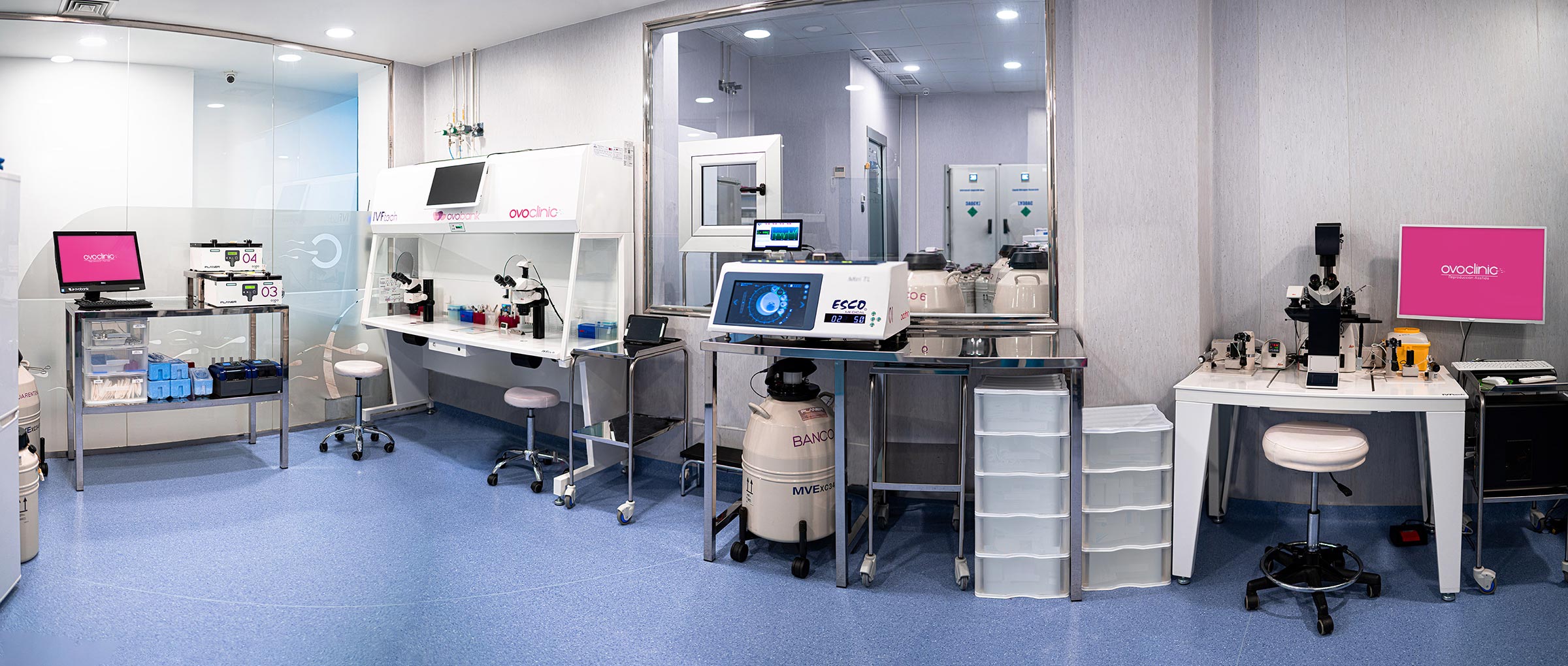
An interesting fact is that the whole laboratory is glassed, so patients can see from the clinic corridor how the embryologists work.
Another piece of equipment present in the IVF laboratory at Ovoclinic Marbella is a laser with which embryo biopsies or assisted hatching are performed.
There are also 6 oocyte and embryo cryopreservation banks, which are frozen using the vitrification method.
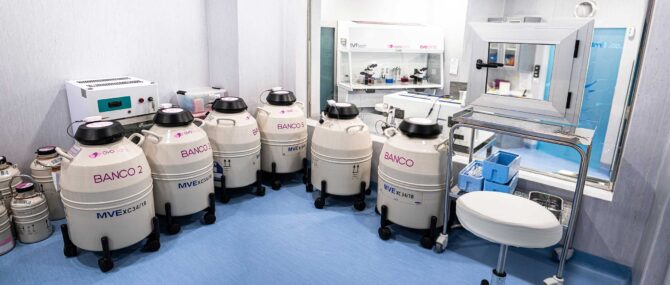
The walls of the laboratory, like those of the operating room, are covered with epoxy paper to facilitate cleaning, there are no right angles on the walls or floor so that dirt does not accumulate and the ventilation system has positive pressure. All this is indispensable to guarantee the maximum conditions of sterility.
Finally, the computerized security and traceability systems for biological samples used at Ovoclinic Marbella are the VRepro and the Ovotracker.
Scientific laboratory
It is right next to the IVF laboratory and equipped with the following equipment: a laminar flow hood with two binocular magnifiers, a microinjector with anti-vibration table, two Planer incubators and two cryopreservation benches.
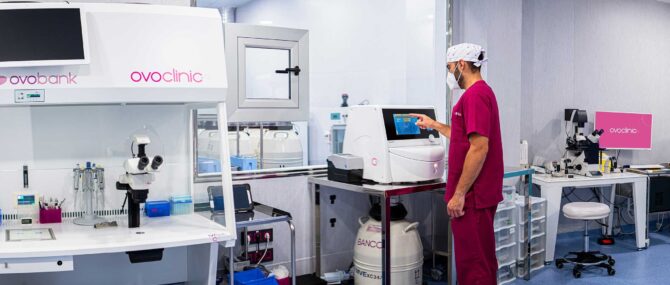
Procedures with eggs and embryos are performed here for research purposes.
Recovery room
Ovoclinic Marbella has a large recovery room with 5 articulated beds separated by panels and a computer table where the nurse is located.
This room is located within the surgical area, that is, in the clean area next to the operating room and the IVF laboratory.
Inside the room, there is a common toilet with individual lockers for patients to leave their things. However, as this is a sterile area, there is no additional seat for the accompanying person.
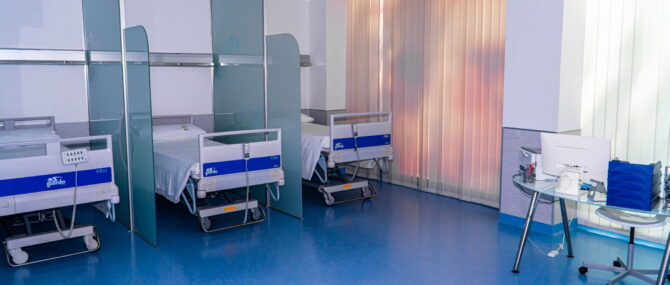
Ovoclinic Marbella offers its patients the service of breakfast or lunch after each intervention.
Sperm collection rooms
FOvoclinic Marbella has two rooms for obtaining semen samples.
Each is equipped with the following amenities: armchair, sink, paper dispenser, television, magazines and adjustable lighting.
These rooms also have a button so that the patient can call in once he or she is finished and the staff comes to collect the sample.
Nursing room
Ovoclinic Marbella has a small room to do the blood draws for the patients.
The resources found here are a stretcher with armrests, a sink, a refrigerator, a storage area and a table.
Once the blood samples are obtained, Ovoclinic Marbella sends them to an external laboratory for analysis.
First visit
Ovoclinic Marbella offers all its patients a free first visit that lasts approximately one hour.
This first visit is informative and is carried out by several professionals: the patient care staff, the gynecologist and the assigned coordinator.
- The gynecologist checks if there are previous reports or analyses provided by the patients, gives an orientation and indicates what the next steps would be.
- The coordinator then shows all the facilities to the patients by giving them a tour of the clinic and, if necessary, gives a quote for the treatment.
- The patient care staff provides all necessary documentation and gives the next appointments.
It should be noted that each patient at Ovoclinic Marbella is assigned a coordinator who accompanies them to each appointment. If they have any questions, patients can contact their coordinator who will help them through the process.
Patient service hours are from 8:00 a.m. to 8:00 p.m. In case of emergency, it is possible to contact patient support outside these hours.
As for international patients, Ovoclinic Marbella has a team of patient care coordinators who speak different languages. These foreign patients have the option of having their first consultation via Skype or telephone.
Gamete donors
Ovoclinic has two platforms for egg and sperm donation. Donors undergo thorough gynecological, serological, and genetic examinations, with only 34% of candidates ultimately being declared suitable.
The strict genetic testing carried out on donors is essential to rule out any type of anomaly or genetic mutation that could affect the future embryo.
As for sperm donors, they also have the possibility of donating at Ovoclinic Marbella, where they undergo all the necessary medical and psychological tests.
Other services
Ovoclinic Marbella patients also have at their disposal other medical specialties that can be of great help in order to achieve success in fertility treatments. They are listed below:
- Psychological support
- Ovoclinic Marbella has a psychologist on staff who helps her patients to keep a healthy and positive mentality towards the treatment.
- Acupuncture service
- these sessions of traditional Chinese medicine are offered before and after the embryo transfer.
- Nutritionist
- nutrition and maintaining an adequate BMI are indispensable factors in achieving a pregnancy.
In addition, Ovoclinic Marbella has a medical committee to deal with cases of high complexity such as recurrent miscarriages, endometriosis, cancer patients, etc.
Success rates
The Spanish Fertility Society is in charge of compiling the results of all the Spanish assisted reproduction clinics every year and making a statistical analysis. In fact, the SEF is the only scientific and independent organization of the clinics that collects and publishes these data in an objective manner.
Although our analysis of this clinic was carried out in 24th February, 2026, we have to indicate that the last report published by the SEF shows the success rates obtained in the year 2023 (National Activity Register 2023-SEF Register).
Normally, there is a delay of about 2 years in the publication of these statistics due to the difficulty in data collection and the controls that are carried out. It should be noted that, to collect data from a gestation achieved in December 2017, we must wait until delivery, which will be approximately in September 2018.
It should also be taken into account that directly comparing pregnancy rates between different clinics can lead to misunderstandings because there are many factors that influence the results, such as the cause of sterility or the particular characteristics of each treatment.
Therefore, the SEF data shown below should be taken as a mere guide. In addition, we recommend reading this article for a better interpretation of the statistics.
IVF/ICSI
Realized cycles
Number of total cycles performed by the clinic in a year.
The SEF does not provide an exact number of annual cycles that each center performs, but rather it does so in the form of ranges as follows: less than 100 annual cycles, between 100 and 500 annual cycles, or more than 500 annual cycles.
From inviTRA we consider that for a better interpretation of the results it would be good that the SEF provides more exact data or smaller ranges for the number of annual cycles.
This is the total number of cycles performed by Ovoclinic Marbella in a year.
Implantation rate per transfer
The probability that an embryo will implant in the woman's uterus after the transfer.
This success rate refers to the probability that a transferred embryo will nest in the woman's uterus. It is calculated as follows: number of gestational sacs observed on ultrasound divided by the number of embryos transferred.
The SEF shows this value in the form of an interval, since it is very complicated to provide an exact percentage due to the variability of factors that we have already discussed.
It should also be taken into account that the more assisted reproduction cycles the clinic performs, the narrower this interval will be and the better the interpretation.
Below, we show the implantation rates per embryo transfer in Ovoclinic Marbella.
Pregnancy probability per transfer
Probability that an embryo transfer will lead to a pregnancy, regardless of the number of embryos transferred.
This success rate refers to the probability of pregnancy for each embryo transfer, regardless of the number of embryos transferred and the type of gestation obtained, that is, whether it is a single or multiple gestation.
The SEF divides this success rate according to the woman's age and is also shown in the form of an interval, so it is likely that very large intervals will be found in clinics that perform few cycles.
These are the pregnancy rates per embryo transfer obtained by Ovoclinic Marbella.
Fresh embryo transfer
Frozen embryo transfer
Percentage of transferred embryos
Percentage of embryo transfers made with one, two or three embryos
According to Law 14/2006 on Assisted Human Reproduction Techniques, in Spain it is only permitted to transfer a maximum of 3 embryos at each attempt.
Even so, a higher percentage of single-embryo transfers is now considered a quality parameter for clinics, since although transfers of two or three embryos increase the rate of gestation, twin or multiple pregnancies have many risks for the mother and babies and must be avoided at all costs.
The recommendation of inviTRA is to transfer only 1 or 2 embryos whenever possible.
In Ovoclinic Marbella they have the following percentages in terms of number of embryos transferred.
Fresh embryo transfer
Frozen embryo transfer
Type of pregnancy per transfer
Types of pregnancies achieved according to the number of embryos transferred
As we have said, a single gestation is the best result that can be obtained after an assisted reproduction treatment.
In the following graphs, the percentage of each type of gestation obtained in Ovoclinic Marbella is shown according to the number of embryos transferred.
Due to the risks associated with multiple pregnancies (lower birth weight, higher probability of premature birth, etc.), the ideal would be to always obtain a single gestation rate of 100%, regardless of having transferred 1, 2 or 3 embryos.
Transfer of fresh embryos
Transfer of frozen embryos
IVF with egg donation
Realized cycles
Number of total cycles performed by the clinic in a year.
As far as egg donation is concerned, these are the ranges of annual cycles performed by Ovoclinic Marbella.
As we have indicated above, the SEF does not provide the exact number of cycles performed by a center and that makes it difficult to interpret.
Implantation rate per transfer
The probability that an embryo will implant in the woman's uterus after the transfer.
The probability of a successful egg donation is usually higher than that of IVF with own eggs.
Taking this into account, these are the implantation rates obtained in Ovoclinic Marbella for IVF with donated eggs.
Pregnancy probability per transfer
Probability that an embryo transfer will lead to a pregnancy, regardless of the number of embryos transferred.
In the case of egg donation, the probability of achieving a pregnancy does not depend so much on the age of the recipient woman. Still, the SEF divides this success rate equally into age ranges.
It should also be noted that the current trend is to perform IVF with frozen donor eggs rather than fresh ones.
These are the pregnancy rates by embryo transfer obtained in Ovoclinic Marbella for egg donation.
Frozen embryo transfer
Percentage of transferred embryos
Percentage of embryo transfers made with one, two or three embryos
Given the high probability of achieving a pregnancy with donated eggs, it is always preferable to transfer a single embryo in this treatment in order to avoid a multiple pregnancy.
In Ovoclinic Marbella the embryos resulting from egg donation are transferred in the following manner.
Transfer of frozen embryos
Type of pregnancy per transfer
Types of pregnancies achieved according to the number of embryos transferred
Finally, these are the types of pregnancies achieved by Ovoclinic Marbella according to the number of embryos transferred in egg donation IVF.
Frozen Embryo transfer
Artificial insemination with donor sperm
Pregnancy rate per cycle
Number of pregnancies per cycle according to the woman's age.
To show the pregnancy rate of donor artificial insemination, the SEF divides the results according to the woman's age.
These are the probability intervals of pregnancy achieved by Ovoclinic Marbella for donor artificial insemination.
Type of gestation by pregnancy
Type of pregnancy obtained after performing an artificial insemination treatment
As for the type of pregnancy obtained after getting a positive result with donor artificial insemination, these are the data obtained by Ovoclinic Marbella according to the woman's age.
It is worth noting the risks that a multiple pregnancy entails for both mother and babies, so the ideal result in any assisted reproduction treatment is a single gestation.
Women under 35 years
User experiences
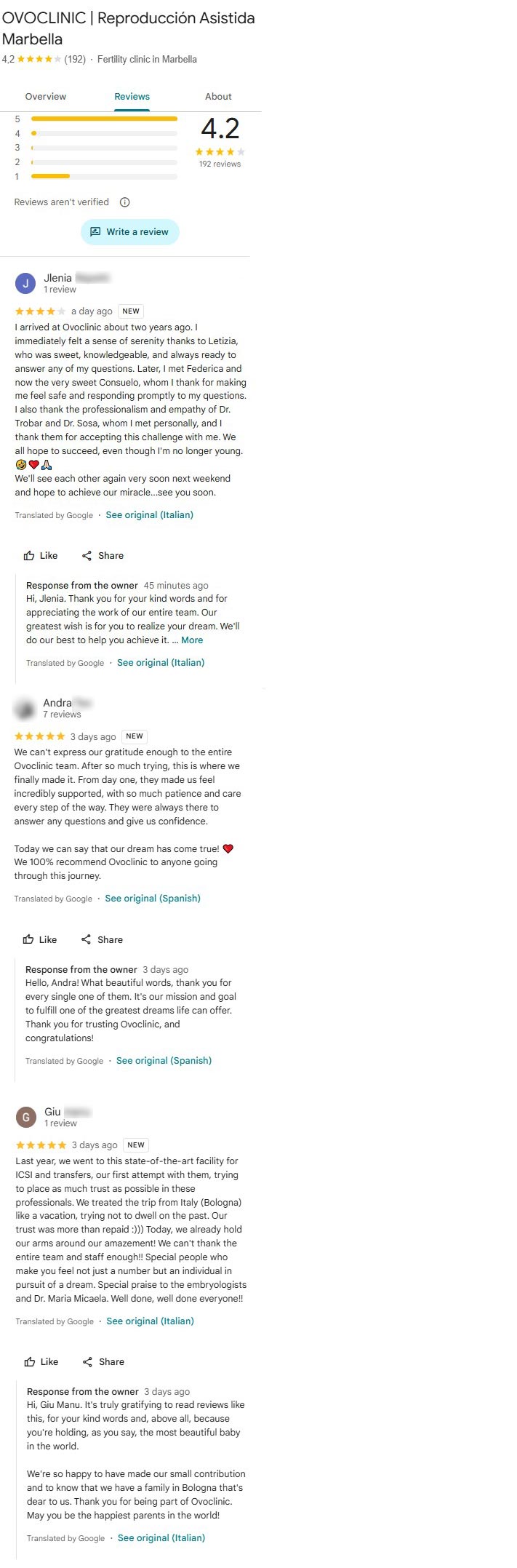
In general, Ovoclinic Marbella has good opinions on the Internet from its patients. In Google Business reviews
For example, the user Jlenia felt very reassured upon arriving at Ovoclinic Marbella. She also highlights the professionalism and empathy of the clinic’s medical team.
Meanwhile, Andrea appreciates the time she was given at Ovoclinic Marbella and felt very well supported from the very beginning.

If you are a patient of Ovoclinic Marbella and would like to share your experience, you can do so in the comments section.
Location of the clinic
Ovoclinic Marbella is located on Avenida Severo Ochoa N/67, just opposite the Marina La Bajadilla marina.
This is the central area of Marbella, so patients have several restaurants, supermarkets and shops nearby, in addition to the promenade and the beach.
Avenida Severo Ochoa, 67, 29603 Marbella, Málaga, Andalusia, SpainHow to get there?
Patients arriving at Ovoclinic Marbella from Malaga can take the A-357 and A-355. You can also take the AP-7 to exit 186, although you have to pay toll fees. The distance from Malaga is about 62 kilometers and, if you come from the airport, about 52 kilometers.
Although it can be a bit complicated in high season, it is possible to find parking in the nearby streets or in an esplanade right next to Ovoclinic Marbella. Parking is free of charge. There is also the Calle Juan de la Cierva parking lot about 200 meters away if necessary.
As far as public transport is concerned, the bus lines with stops near Ovoclinic Marbella are the L-60 (Fuengirola - Marbella (Direct)), the L-76 (Hospital Costa Del Sol - Marbella - Nueva Andalucía), the L-78 (Hospital Costa Del Sol - Marbella - San Pedro) and the M-220 (Fuengirola - Marbella).
Conclusion
Ovoclinic Marbella is a good clinic to carry out any fertility treatment, as they have all the technology and personnel necessary to do so.
Its facilities are very comfortable and innovative, from individual waiting rooms to laboratories with glass walls. The staff at Ovoclinic Marbella takes care of every last detail so that patients do not feel alone on this hard road to motherhood.
In addition, Ovoclinic Marbella offers guarantee and birth programs that adapt to your needs, providing peace of mind and confidence to patients who wish to undergo assisted reproduction treatment.
If you have any doubts when choosing a fertility clinic, we can give you more recommendations and advice such as those found in the article Things to Consider to Choose the Right Fertility Clinic for You.
We make a great effort to provide you with the highest quality information.
🙏 Please share this article if you liked it. 💜💜 You help us continue!