How to deal with miscarriage after an in Vitro Fertilization (IVF)?
A miscarriage is always bad news, but it is especially painful for those who, after several months of searching for pregnancy, achieve it thanks to in vitro fertilization (IVF) treatment.
The happiness that a couple feels at the expected positive result in the pregnancy test is truncated by the sadness of the gestational loss. Should this situation unfortunately occur, patients should take the necessary time to recover before attempting another fertility cycle.
The different sections of this article have been assembled into the following table of contents.
Contents
- 1.
- 1.1.
- 2.
- 2.1.
- 3.
- 4.
- 5.
- 5.1.
- 5.2.
- 5.3.
- 5.4.
- 6.
- 7.
Why did I have a miscarriage?
Approximately 85% of spontaneous or natural abortions occur in the first trimester of gestation. If the pregnancy reaches week 7 normally, the probability of miscarriage is significantly reduced.
Most miscarriages occur when the pregnancy is not progressing properly. Generally, in these cases, neither the woman nor the physicians can do anything to prevent gestational loss.
Causes of non-evolving pregnancies after IVF
Chromosomal abnormalities in the embryo are the most frequent cause of the embryo not being able to follow its normal development. This does not necessarily imply that the parents have genetic alterations. What happens is that the egg and/or the sperm from which the embryo is formed have undergone some alteration in their chromosomes that prevents the implantation or evolution of the embryo.
One of the factors that influence the appearance of anomalies in the embryo is maternal age. However, it is not the only cause of miscarriage after IVF. Other possible reasons why a miscarriage may occur in the first few months are as follows:
- Uterine or cervical problems.
- Infections
- Hormonal alterations
- Immune system problems.
- Systemic diseases.
- Environmental toxins or radiation.


When a woman has suffered previous miscarriages, the probability of suffering a new gestational loss also increases. In addition, an inadequate lifestyle such as smoking, drinking alcohol or taking drugs also influences the risk of miscarriage.
If you wish to read more information about the reasons for miscarriages, we advise you to visit the following link: What are the main causes of miscarriage?
Miscarriage in in vitro fertilization (IVF)
Studies on this subject indicate that miscarriages in patients who have achieved pregnancy by IVF with their own eggs (regardless of whether it is conventional IVF or ICSI) are slightly higher than the miscarriage rate in spontaneous pregnancies.
However, it should be noted that this increase in the incidence of miscarriages is not due to the IVF technique itself, but is associated with the age of women undergoing assisted reproduction treatments. This substantially affects female fertility, not only when it comes to conceiving, but also in relation to the risk of miscarriage.
IVF miscarriage rate according to maternal age
As we have previously mentioned, one of the causes of miscarriage after assisted reproduction treatment is advanced maternal age. Depending on the woman's age, the probability of miscarriage after IVF gestation with the woman's own eggs is higher in women:
- Under 35 years of age: 16.1%
- Between 35-39 years old: 26.4%
- Being a woman over 40 years: 36.4%

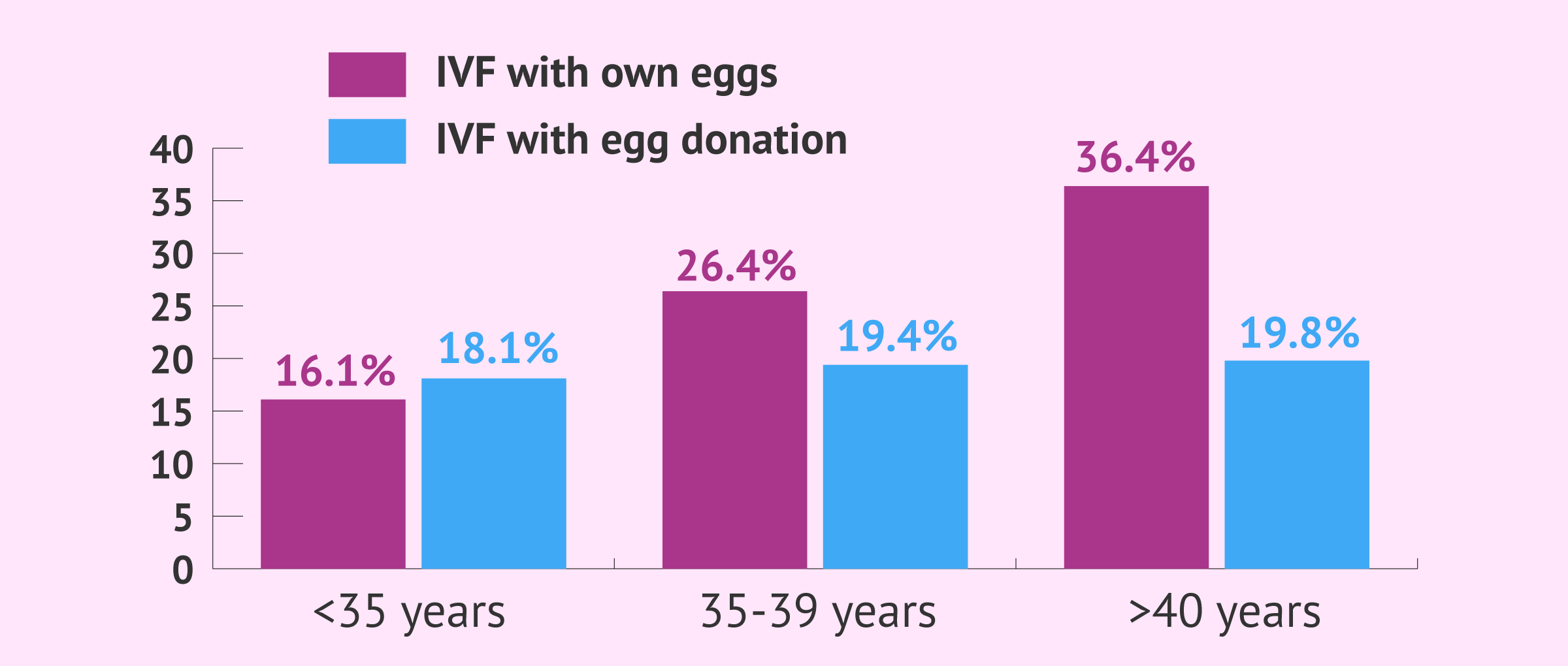
In contrast, miscarriage rates are drastically reduced if pregnancy would have occurred through IVF with oocyte donation. In this case, the probability of gestational abortion in women under 35 years of age would be 18.1%, in women between 35 and 39 years of age 19.4%, and in women over 40 years of age it would have been reduced to 19.8%.
The main reason for these values is that the older the age, the higher the risk of conceiving embryos with chromosomal abnormalities.
All these data have been obtained from the latest statistical registry carried out by the Spanish Fertility Society and corresponding to the year 2022.
Statistical data in this article shall not be used to imply or predict an outcome certainty to a specific individual within a population at risk.
Coping with gestational loss
Coping with sadness, anger and helplessness in the face of a miscarriage after a long time of searching for a baby is not easy for a woman or a couple.
However, you have to be strong, take your time and, if necessary, ask for help from professionals. In any case, here are some tips for emotional help in dealing with these situations:
- Patients have the right to be sad and do not have to hide it.
- It is necessary to give yourself time to recover from the loss, because abortion is a mourning process that has its phases. Patients will have to go through one of them at home, so time is necessary.
- Pay attention to try to understand and accept the feelings you have in each phase. Empathy, sadness, guilt, depression or anger are some of the most common feelings.
- Taking care of yourself. It is a tough stage, but if it is neglected it will be even tougher. There is no need to stop eating, sleeping or taking care of yourself, in general.
- Asking for help from a professional with experience in these matters can be of great help in understanding and coping with gestational loss.
- Let the environment help you. You may prefer to be alone, but recovery from pregnancy loss will go better if you feel supported, either by your partner, family or friends.

Approximately one to two months is the time it takes for a woman's body to recover after an abortion. However, emotional recovery is often longer and more costly. Therefore, it is essential to be patient and try to maintain a positive attitude at all times.
What to expect after an abortion?
Most women who have had a miscarriage do not have problems getting pregnant again and do not need specific treatments to be able to give birth to healthy children in the future.
However, when more than one miscarriage occurs, known as recurrent or repeat miscarriage, a complete medical evaluation is recommended. This will allow us to determine the causes of gestational losses and to propose the best alternative to achieve full-term pregnancy.
Considering undergoing a fertility treatment? By getting your individual Fertility Report your will see different clinics especially selected for you out of the pool of clinics that meet our strict quality criteria. Moreover, it will offer you a comparison between the fees and conditions each clinic offers in order for you to make a well informed choice.
When the cause of recurrent miscarriages is known, it is possible to personalize the treatment and use specific therapies. In those cases in which the reason for the miscarriage is not discovered, generic treatment based on the administration of aspirin, heparin and progesterone significantly improves the results.
In addition, if there is a genetic cause for repeated miscarriages, assisted reproduction offers alternative solutions to achieve pregnancy. For example, one option would be to resort to IVF with egg donation or to perform preimplantation genetic diagnosis (PGD) on the embryos before transferring them.
FAQs from users
Can a missed abortion occur in IVF with donor eggs?
Yes, it is true that the risk of miscarriage may be reduced in oocyte donation if the woman is of advanced maternal age, as eggs from a young donor are used. However, the risk of miscarriage would be around 25%, so it can occur.
It should be clarified that a missed or missed abortion is a gestational loss in which the embryonic remains are not spontaneously expelled.
Read more
Is it normal to have a missed abortion in ovodonation?
Yes, it is possible to have a missed abortion in an IVF treatment with donor eggs.
We define miscarriage as uninduced embryonic or fetal loss before the 20th week of gestation. A missed or delayed abortion is characterized by the arrest of gestation without spontaneous expulsion of the embryo or fetus and usually occurs between the second and third trimester of pregnancy.
As with other types of miscarriages, one of the main causes is a genetic or chromosomal alteration in the development of the fetus. Likewise, infections, endocrine or hormonal disorders or problems in the uterus or cervix can also cause a miscarriage in the first weeks of gestation.

The risk of miscarriage is around 25% after the age of 35, while it increases to 50% in women over the age of 40. If we apply these percentages to egg donation, we know that the risk of miscarriage in egg donation is around 25% because the oocytes come from women under 35 years of age. So it may be normal in an oocyte donation treatment to have a missed abortion.
Read more
How to deal with negative IVF?
Dr. José León Tovar, gynaecologist at Ginemed Huelva, gives us the guidelines to follow when IVF does not go well. As the doctor tells us:
A negative IVF, in the first instance, must be dealt with as something normal. IVF or ICSI does not have a 100% success rate, that is a lie. Within the percentages of success, which are normally similar in all clinics, you have to take it as normal before a case of negative beta. When we already have an implantation failure, that is to say, several transfers of good quality embryos and if they are euploid analysed with preimplantational genetic diagnosis, we would already think about other strategies. The patient must undergo a thrombophilia study, of course, the karyotype is decisive, and a study of endometrial receptivity. Depending on the results, then put in heparin, aspirin, immunosuppressants, adjuvant therapy whenever it is justified according to the analytical results.
Why does IVF with PGD decrease the miscarriage rate?
When IVF with PGD is chosen, there is less chance that the pregnancy will not be carried to term. This is because one of the main causes of miscarriage is that the embryos are chromosomally altered due to advanced maternal age.
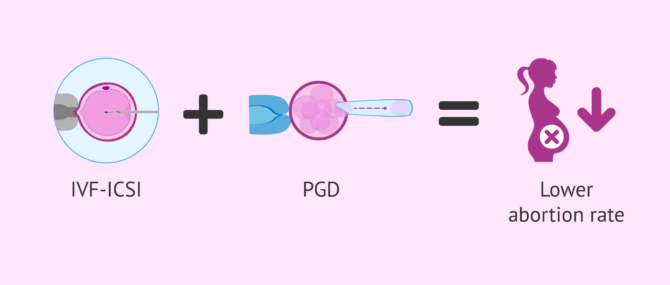
If the embryos are genetically analysed, only those that are healthy and therefore have no genetic abnormalities will be transferred. In this way, there is a higher probability of embryo implantation and evolution until delivery.
Recommended reading
If you have recovered from the gestational loss after IVF and you are wondering if you can get pregnant again, we recommend you to visit the following article: Fertility after abortion: Is pregnancy possible?
In addition, if you are interested in knowing more data about the different IVF success rates, you can access this link: What are the success rates of in vitro fertilization (IVF)?
We make a great effort to provide you with the highest quality information.
🙏 Please share this article if you liked it. 💜💜 You help us continue!
References
Kai Mee Wong, Madelon van Wely, Femke Mol, Sjoerd Repping, Sebastiaan Mastenbroek. Fresh versus frozen embryo transfers in assisted reproduction. Cochrane Database Syst Rev. 2017 Mar 28;3(3):CD011184 (View)
María Del Carmen Nogales, María Cruz, Silvia de Frutos, Eva María Martínez, María Gaytán, Marta Ariza, Fernando Bronet, Juan A Garcia-Velasco. Association between clinical and IVF laboratory parameters and miscarriage after single euploid embryo transfers. Reprod Biol Endocrinol. 2021 Dec 14;19(1):186. doi: 10.1186/s12958-021-00870-6 (View)
Maya Sharon-Weiner, Hadar Gluska, Sivan Farladansky-Gershenabel, Hanoch Schreiber, Amir Wiser, Adrian Shulman, Anat Hershko-Klement. Conception after early IVF pregnancy loss: should we wait? Reprod Biomed Online. 2021 Feb;42(2):413-419. doi: 10.1016/j.rbmo.2020.10.019. Epub 2020 Nov 4 (View)
Sociedad Española de Fertilidad. Registro Nacional de Actividad 2020-Registro SEF (View)