Spanish Fertility Society (Sociedad Española de Fertilidad – SEF)
The Spanish Fertility Society (SEF) is a non-profit scientific society whose purpose is to promote studies on fertility and assisted reproduction. It is also responsible for advising the State Administration and other entities, as well as for disseminating knowledge.
It is one of the most important entities at the medical level and makes various documents related to human fertility available to the public.

The different sections of this article have been assembled into the following table of contents.
Contents
- 1.
- 1.1.
- 2.
- 2.1.
- 3.
- 4.
- 5.
- 6.
- 6.1.
- 6.2.
- 6.3.
- 6.4.
- 7.
- 8.
History of the SEF
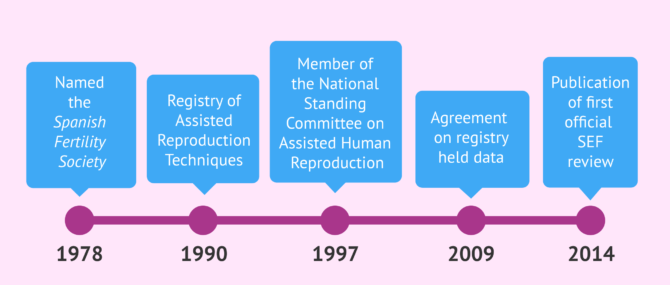
It was founded in 1953 by José Botella Llusiá, researcher and physician specialized in gynecology and obstetrics. This society was named Sociedad Española para el Estudio de la Esterilidad (Spanish Society for the Study of Sterility) and became affiliated to the International Federation of Fertility Societies (IFFS). Some of the important dates for the history of the entity are:
- In 1978 it was renamed the Spanish Fertility Society.
- In 1990 the Registry of Assisted Reproduction Techniques was created.
- In 1997 the SEF became a member of the National Standing Committee on Assisted Human Reproduction.
- In 2009, an agreement was signed with the Spanish Ministry of Health and Social Policy on the transfer and management of data included in the registry.
- In 2014, the first Official Journal of the SEF was published: Reproductive Medicine and Clinical Embryology (MEDRE).
In addition, the president of the SEF is a position that has changed since its creation and is currently chaired by Luis Martínez Navarro.
Awards
Throughout its years, the SEF has received several awards for its activity in the field of assisted reproduction and fertility. Some of these are indicated below:
- Quality Award in the National Health System in 2010. This was awarded for its publicly accessible information system for assessing the quality of care provided by assisted reproduction centers in 2010.
- Gold Star Award which was awarded by the Institute for Professional Excellence in recognition of its professional work and commitment to Excellence in 2015.
Project objectives
The main objective of the SEF is to promote studies and their application to social problems related to fertility. In addition, the SEF collaborates with the State Administration and other entities (associations, provincial corporations, foundations, etc.) related to reproductive health. The organization also advocates continuing education in Spain.
Finally, the SEF establishes and awards accreditations to Spanish fertility professionals or centers that meet quality requirements in terms of care and operation.
The SEF organizes the National Congress of the Spanish Fertility Society every two years.
Books and publications
The SEF, its interest groups and collaborators are responsible for publishing various works on fertility and reproductive biology. Thus, there are a multitude of publications and books that are useful for all those interested in the field of reproduction and fertility. Some of the documents are free of charge, while others must be paid for.
The following is a list of the most important publications:
- Management of the patient with endometriosis during childbearing age.
- Recommendations for the management of recurrent miscarriage.
- Impact of infertility and underlying endocrine pathologies on descendents.
- Manual of andrology.
- Implantation failure in assisted reproduction.
Operating regulations
Interest groups must have a defined structure with specific objectives and in accordance with the rules of the Board of Directors of the Company. In addition, the idea of working in collaboration with other interest groups allows the SEF to approach the functional structure of other scientific societies related to assisted reproduction. All this must be done without bureaucratization or causing a repetition of functions and tasks in the society.
Success rates provided by the SEF
The success rates of assisted reproduction treatments are of great importance for patients, as they allow them to analyze the best clinic to go to in order to achieve pregnancy.
These data are published annually by the SEF, whose members are in charge of compiling all the results obtained by Spanish fertility centers and performing a statistical analysis. The latest report published by SEF shows the results for 2021 (2020 National Activity Registry-SEF Registry).
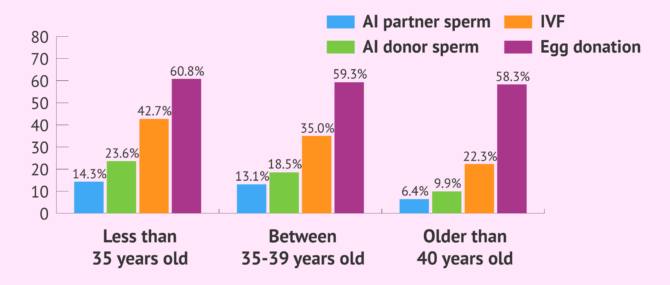
The SEF represents the success rates differentiated into 3 age ranges of women. In addition, it takes into account whether the gametes are from own or donated origins, the implantation rate, the clinical pregnancy rate, delivery rate, and so on.
In summary, assisted reproductive techniques and their success rates include the following:
- Artificial insemination with partner or conjugal sperm
- is the simplest treatment and the highest success rate occurs in women under 35 years of age. The possibility of achieving pregnancy with one's own gametes decreases with increasing age.
- Artificial insemination with donor sperm
- in this technique, donor sperm is used, so the probability of achieving pregnancy is higher than with partner sperm.
- In vitro fertilization (IVF)
- is used in more severe cases of infertility. Its success rate corresponds to the use of the couple's own gametes (eggs and sperm) and the greatest possibility of pregnancy is when the woman is less than 35 years old.
- IVF with egg donor.
- in this case, the woman's age is not a determining factor for the success of the pregnancy, since the eggs come from young and healthy donors.
For more information on the success of the different assisted reproduction techniques, please visit the following link: An analysis of success rates of assisted reproduction treatments.
Bioethics consultation service
This service consists of counseling from a bioethical and legal point of view in the field of assisted reproduction, since the subject generates great controversy. It focuses on solving problems derived from the relationship with patients, professional responsibilities, gamete donation and so on.
It is a confidential service and subject to professional secrecy, so the information will only be known by the advisor providing the assistance. There will be no intermediary person.
FAQs from users
What are the functions of the Spanish Fertility Society (SEF)?
The main functions of the SEF (Spanish Fertility Society) are: to promote the study of fertility, to organize and collaborate with different fertility societies and to support the study and research of infertility.
The SEF works closely with the Ministry of Health, Consumption and Social Welfare in the elaboration of the National Registry of Assisted Reproduction Activity. This guarantees that patients who receive assisted reproduction treatment are protected and protected within a framework of good medical practice.
Furthermore, the SEF has been driving and promoting the assisted reproduction sector in Spain for more than 60 years, which has placed this country among the most advanced in the reproductive sector.
Read more
Who can make up a SEF interest group?
Membership in the Interest Groups is open to all SEF members who wish to join and request to do so. In this way, any member will be able to propose ideas for projects and receive news about other projects. This correspondence will be processed through the SEF secretary.
Are there any requirements for the creation of SEF interest groups?
The creation of Interest Groups should only take into account efficiency criteria aimed at avoiding excessive dispersion of efforts.
Under which law is the SEF regulated?
The SEF is generally governed by the Spanish Organic Law 1/2002, of March 22nd, which regulates the Right of Association. In addition, it is based on the different Statutes and the agreements of the General Assembly and the Board of Directors.
Recommended reading
If you want to know more about the different possilbilities to help you achieve pregnancy, you can visit the following link: Fertility treatments for couples: how to achieve pregnancy?
Alternatively, if you want to learn more about the success rate of IVF with donor sperm, we recommend that you read the article: IVF with donor sperm: process and success rates.
We make a great effort to provide you with the highest quality information.
🙏 Please share this article if you liked it. 💜💜 You help us continue!
References
Sociedad Española de Fertilidad. Registro Nacional de Actividad 2021-Registro SEF. (Ver)