
Many women have clots in their menstrual bleeding and this can be considered normal. Generally, these clots are due to heavy bleeding, are usually not large, and do not cause pain.
However, there are certain situations in which clots in the period may indicate underlying pathology, so it will be advisable to consult a specialist so that he/she can assess the causes of menstrual clots.
Provided below is an index with the 8 points we are going to expand on in this article.
- 1.
- 2.
- 3.
- 3.1.
- 3.2.
- 4.
- 4.1.
- 4.2.
- 4.3.
- 4.4.
- 4.5.
- 4.6.
- 4.7.
- 5.
- 6.
- 7.
- 8.
What are menstrual clots?
Menstruation is the beginning of a woman's menstrual cycle. This is the shedding and expulsion of the endometrium, which is the mucous membrane that lines the uterus, as a result of the failure of the previous menstrual cycle to produce a pregnancy.
The endometrium will grow again to be in the best conditions for the next cycle since it is the layer where the embryo must implant.
Although this menstrual bleeding usually flows smoothly, some women notice small clots or "lumps" in their menses. The consistency of these clots can be gelatinous or thick and their size usually does not exceed that of a coin.
As for the color, the clot may be deep red or a stronger red than the rest of the menstrual bleeding. In addition, this color may vary depending on the day of menstruation, since at the end of the period the clots will tend to have a darker color, almost brown.

In general, the expulsion of these clots in the period is completely normal in many women and should not be a cause for concern.
However, menstrual clots are a reason to consult a specialist if they are frequent, large, or occur with other symptoms. The reason is that, in these cases, the presence of clots may be related to some pathologies.
Why are there clots in the period?
Menstrual clots usually occur when menstrual bleeding is very heavy. In fact, it is more common for women to observe these clots in the first days of menstruation when bleeding is usually more intense.
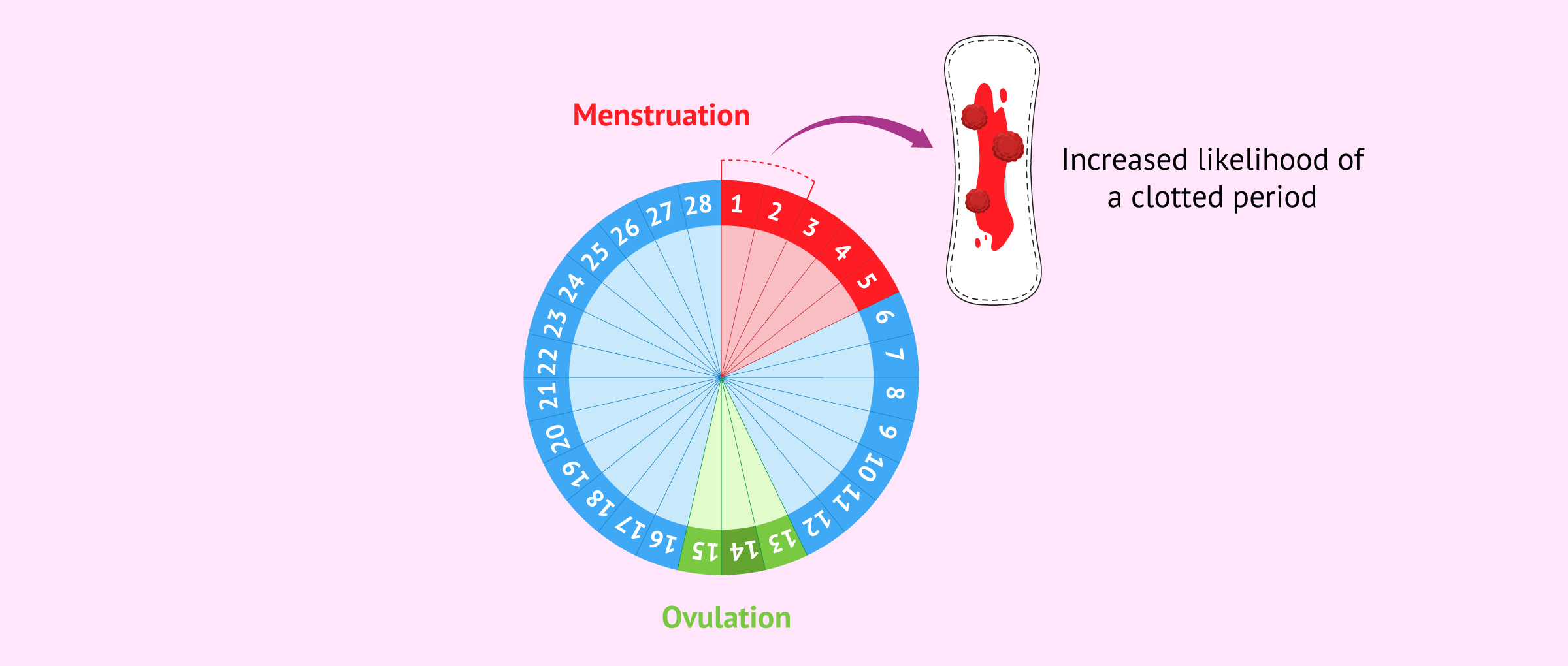
However, the presence of clots in the period may be a one-time occurrence. The amount of menstrual bleeding is different in each cycle for the same woman. Thus, it is possible that there may be clots only at a certain period or because of a temporary hormonal imbalance.
When can they indicate pathology?
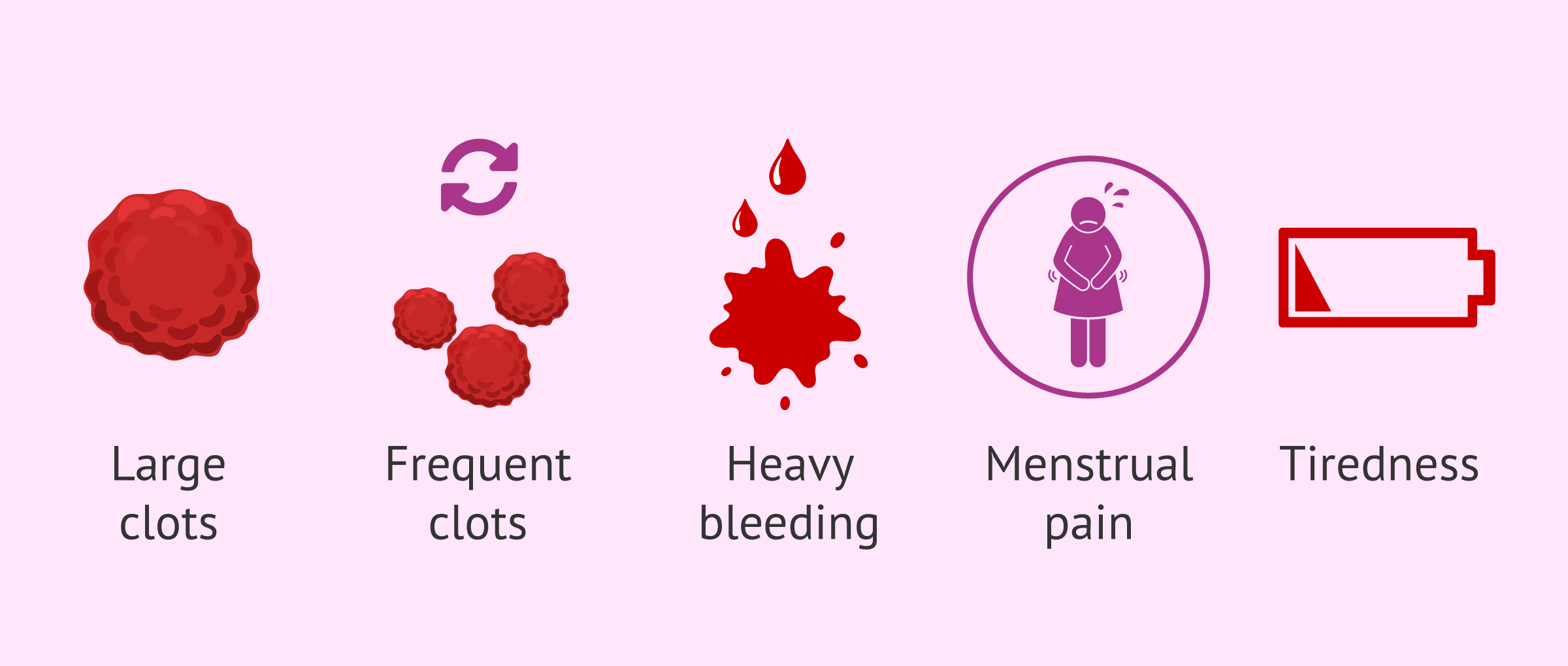
A woman should see a specialist if she has clots of considerable size or very frequent clots in her menstruation. Likewise, the woman should also go for consultation if the clots occur together with symptoms such as the following:
- Heavy bleeding, which requires changing the menstrual pad, tampon or menstrual cup every few days.
- Menstrual pain.
- Tiredness and fatigue.
In this case, it may be useful for the woman to write down the characteristics of her menstruation (duration, time at which she renews the pad, tampon, or menstrual cup...) and of the clots (texture, size, color, days of appearance, if it is the first cycle that they are expelled...), as well as all the symptoms she has experienced.
Possible pathologies
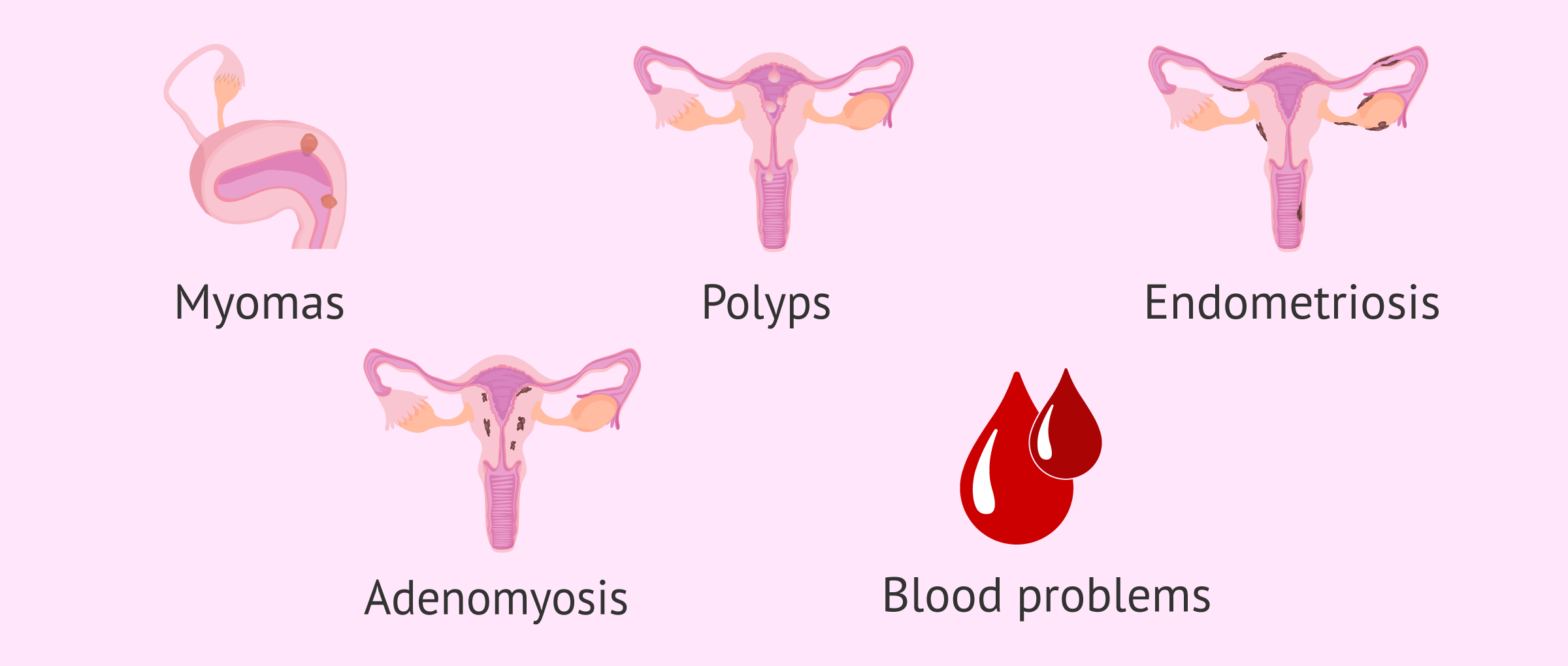
There are different situations that can lead to the appearance of menstrual clots. Among them, we can mention the following:
- Hormonal imbalance: altered levels of sex hormones can cause the appearance of clots in menstrual blood.
- Fibroids or polyps: Uterine growths in the form of fibroids or polyps may be accompanied by heavy menstrual periods and the expulsion of clots.
- Endometriosis: this is a pathology in which endometrial tissue grows outside the uterine cavity. A woman with endometriosis has very painful menstrual periods, which may also be heavy.
- Adenomyosis: is the presence of endometrial tissue in the muscular layer of the uterus and can also cause heavy menstruation with clots.
- Blood problems: Certain blood conditions such as von Willebrand' s disease can cause very heavy menstrual bleeding.
However, the frequent occurrence of clots and heavy periods may also be caused by the woman having an enlarged uterus or by iron deficiency anemia.
On the other hand, if the woman is seeking pregnancy, heavy bleeding and the appearance of large yellow or grayish clots could indicate a miscarriage.
Diagnosis
When a patient sees a gynecologist for the presence of clots in menstruation, the gynecologist will ask about her medical history and may perform different tests depending on her symptoms.
In general, the woman will undergo an ultrasound to evaluate the uterine cavity in search of any alteration such as fibroids. In addition, the patient will be asked to have a blood test to see if she is anemic, for example.
Thus, the specialist will be able to investigate the causes of menstrual clots, in order to be able to indicate to the woman the appropriate treatment if necessary, which will depend on the situation and the reproductive desires of the patient.
FAQs from users
Can clots in menstruation indicate infertility?
It does not have to be. If a cause that may also affect fertility is ruled out, it is possible to have abundant periods, with clots, without these indicating a problem. However, you should check that it does not lead to anemia and, if it does, treat it.
Read more
Is it normal to have clots during menstruation?
Yes, most women have had clots in their menstrual bleeding at least once and usually on several occasions. The size as well as the color varies between women and between periods of the same woman depending mainly on the cause.
Could clots in the period bleeding be the cause of period pain?
Clots themselves do not cause pain, but they usually appear when bleeding is heavy and dense and this can influence menstrual pain. Both pain and the appearance of clots can be symptoms of increased vaginal bleeding.
How can I reduce clots in menstruation?
There is no clear way or method for the occurrence of clots in the period. However, it is advisable to lead a healthy lifestyle that allows for proper overall blood circulation. It is recommended to reduce stress and consume foods rich in bioflavonoids such as broccoli, grapes, citrus fruits, cherries, tomatoes, or green peppers to help strengthen blood vessels and reduce clotting.
On the other hand, if the appearance of clots is very common or is accompanied by pain, it is advisable to consult a doctor. Normally, in these cases, the specialist will prescribe some medication to help control vaginal bleeding such as birth control pills, aspirin, or mefenamic acid.
Could the myoma be the cause of the clots in the period?
Yes, fibroids and cysts can increase the occurrence of bleeding or cause alterations in bleeding that lead to clots. In any case, having a fibroid does not necessarily indicate that the vaginal bleeding has clots.
Does menstruation with or without clots favor pregnancy?
Clots usually do not affect conception. The fact that vaginal bleeding has clots does not indicate that pregnancy will be more or less easy to achieve. If clots are common and pregnancy does not occur, it is advisable to consult a specialist in case there is a problem with the receptivity of the endometrium.
Is it bad to have a period with brown or brown clots?
It doesn't have to be. It is true that clots in menstruation may be more frequent in the first days of menstruation, when the bleeding is more abundant and, therefore, usually have a deep red or darker red color than the rest of the bleeding. Thus, dark brown or coffee-colored clots may appear at the end of the period, as the blood is "aged".
In general, clots in menstruation are normal and occur in many women. However, if these clots appear frequently, are large and/or are accompanied by symptoms such as heavy bleeding, pain or tiredness, it is best to consult a specialist, as they may be caused by an underlying pathology.
Recommended readings
If you are interested in learning more about menstruation, we recommend you visit the following link: Menstruation: symptoms and characteristics of bleeding.
On the other hand, if you want to learn more about the menstrual cycle, you can read this article: The menstrual cycle: what happens in each of its phases?
Community and Support
At inviTRA we work to make monthly and rigorous information accessible to everyone. If this article has helped you, consider supporting us so we can continue accompanying more people on their journey to parenthood.
References
Beller FK. Observations on the clotting of menstrual blood and clot formation. Am J Obstet Gynecol. 1971 Oct 15;111(4):535-46. (See)
Borzutzky C, Jaffray J. Diagnosis and Management of Heavy Menstrual Bleeding and Bleeding Disorders in Adolescents. JAMA Pediatr. 2020 Feb 1;174(2):186-194. (See)
Bradley LD, Gueye NA. The medical management of abnormal uterine bleeding in reproductive-aged women. Am J Obstet Gynecol. 2016 Jan;214(1):31-44. (See)
Davies J, Kadir RA. Heavy menstrual bleeding: An update on management. Thromb Res. 2017 Mar;151 Suppl 1:S70-S77. (See)
James AH. Heavy menstrual bleeding: work-up and management. Hematology Am Soc Hematol Educ Program. 2016 Dec 2;2016(1):236-242. (See)
Whitaker L, Critchley HO. Abnormal uterine bleeding. Best Pract Res Clin Obstet Gynaecol. 2016 Jul;34:54-65. (See)
FAQs from users: 'Can clots in menstruation indicate infertility?', 'Is it normal to have clots during menstruation?', 'Could clots in the period bleeding be the cause of period pain?', 'How can I reduce clots in menstruation?', 'Could the myoma be the cause of the clots in the period?', 'Does menstruation with or without clots favor pregnancy?' and 'Is it bad to have a period with brown or brown clots?'.
Authors and contributors


More information about Cristina Algarra Goosman


Hi, this last period I noticed a couple of clots, I have never had this happen before and I don’t know if it is something to worry about.
Hello Naive,
As a general rule, the presence of clots in menstruation is normal. There is no need to panic.
On the contrary, it is necessary to take into account the size of these clots and the frequency with which they appear. If they occur frequently or are larger than the size of a coin, you should see your doctor for a check-up.
It is also important to see a doctor if these clots are accompanied by heavy bleeding, pain, or fatigue.
I hope I have helped you,
Best regards.
Hi, I have always had clots in my period, after my first pregnancy this changed, now I don’t have so many clots and we are going to try for the second pregnancy but I am afraid that something has changed because of that, is it possible?
Hi Queenie,
The presence or absence of menstrual clots has no influence on the ability to conceive, i.e. it is not a synonym for infertility.
After 12 months of pregnancy search or 6 months, if you are older than 35 years, it is recommended to go to an assisted reproduction clinic. I leave you our directory of clinics where we analyze the clinics in your area.
I hope I have helped you,
Best regards
Hello! I’m 26 and I pass heavy blood clots during menstruation… My gynecologist told me it’s normal but I would like to know whether it is possible to donate them. I mean, there are people suffering from anemia and here I am wasting large amounts of blood… how ironic, isn’t it?