What are the possible causes of endometriosis?
Endometriosis is a disease characterized by the implantation of endometrial tissue outside the uterus. The endometrium is the inner lining of the uterus and is hormonally stimulated each month to prepare for a possible pregnancy. However, if pregnancy does not occur, the endometrium is shed, resulting in menstruation.
In endometriosis, on the other hand, the endometrial tissue is also found in other parts of the body outside the uterine cavity. This tissue can be found in numerous locations. However, endometrial tissue is most often found in the ovaries and abdominal cavity.
There are several theories that could be involved in the origin of endometriosis, although the exact causes are unknown.
The different sections of this article have been assembled into the following table of contents.
Contents
- 1.
- 1.1.
- 1.2.
- 1.3.
- 1.4.
- 2.
- 2.1.
- 2.2.
- 3.
- 4.
- 4.1.
- 4.2.
- 4.3.
- 4.4.
- 5.
- 6.
Theories of the causes of endometriosis
Since the discovery of endometriosis, various explanations for its origin have been proposed. Despite this, none of the theories come close to clarifying the mechanism of action and the very diverse localization of endometriosis. This is why the etiology of the disease has not yet been clarified. Some of the most important theories are mentioned below.
Retrograde menstruation (Sampson's theory)
According to this theory, endometriosis occurs because some of the endometrial tissue flows backward instead of flowing outward as is usual with menstruation. Thus, the endometrial tissue would flow through the fallopian tubes into the abdominal cavity. Once there, the endometrial cells could attach and produce endometriosis implants.


Despite being the most accepted theory, approximately 90% of women may have retrograde flow and it is estimated that as few as 15% have endometriosis. Furthermore, this theory would also not explain the presence of endometriosis in sites outside the abdominal cavity, in girls who have not yet had menstruation, and in men. Therefore, there must be other types of factors involved in the causes of endometriosis.
Cellomic metaplasia (Iwanoff-Meyer theory)
Metaplasia is the transformation of one cell type into another. Thus, this theory explains that peritoneal cells could change into endometrial cells. The triggering factor for this change could be the response to inflammatory processes or be due to hormonal or environmental stimuli.

The Iwanoff-Meyer theory would explain why endometriosis is not only present in women, as the endometrium could come from other tissue. This hypothesis could also explain other cases of endometriosis, for example, in women who do not menstruate.
Lymphatic or vascular dissemination
This theory points out that endometrial tissue could circulate through blood vessels or the lymphatic system to other parts of the body. This may explain how endometriosis can develop in distant sites from the pelvic cavity, such as the lung.

However, this explanation alone fails to clarify how the adhesion necessary to form the endometriotic implant occurs at these distant locations.
The embryonic remnant theory
This theory proposes that residual Müllerian cells, possibly upon estrogen stimulation at puberty, could be the origin of endometriosis.
However, according to this theory endometriosis should appear with menarche and this is not always the case, since the incidence of endometriosis is higher after the age of 25.
Factors for the development of endometriosis
Endometriosis appears to require different molecular factors that favor the adhesion, growth, survival, invasion, and blood vessel formation of endometrial tissue.
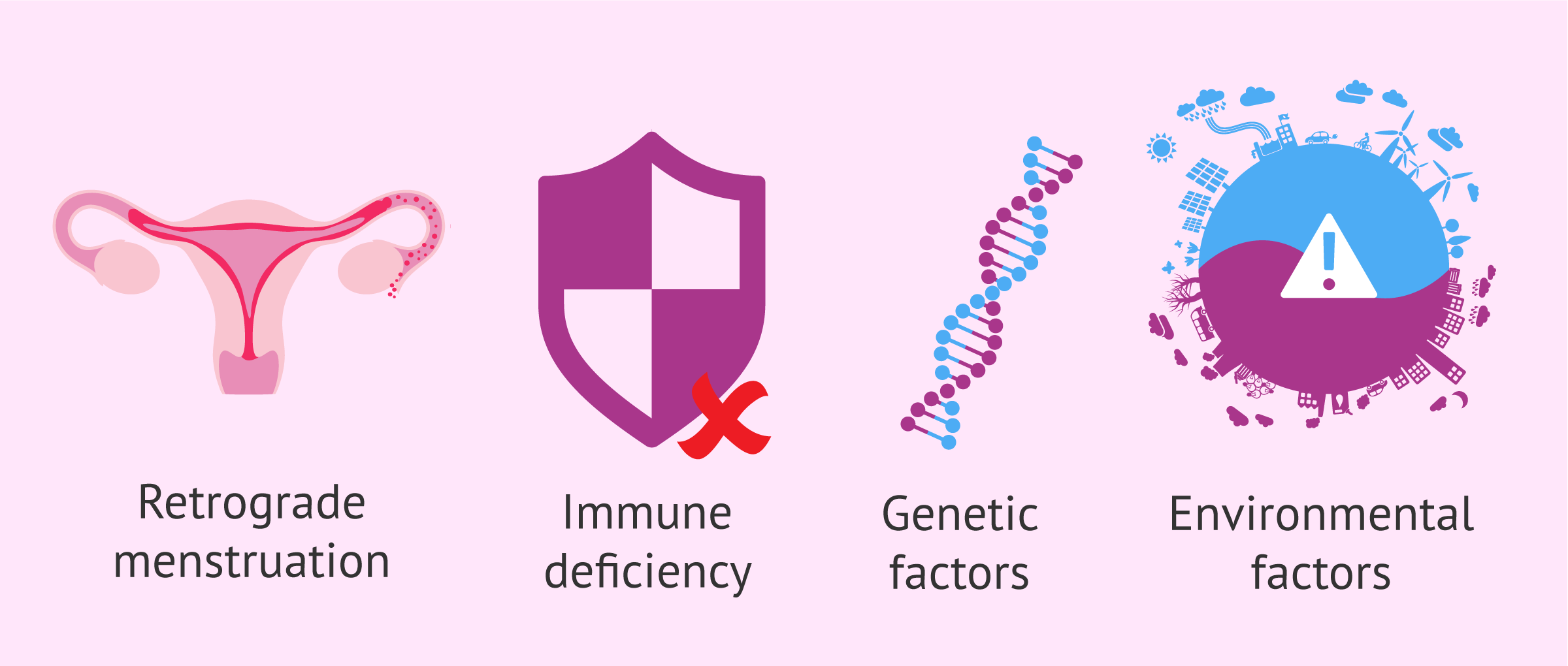
It is believed that both retrograde menstruation and some environmental factors, certain genetic alterations, and immune deficiency may be important in the development of endometriosis.
Disrupted immunity
Different research indicates that the immune system plays a key role in the onset, maintenance, and progression of endometriosis.
Retrograde menstruation is very common and under normal conditions, the debris released into the pelvic cavity is removed by cells of the immune system. However, in endometriosis, the cells of the immune system would have their function altered and would be deficient. Therefore, they would not be able to eliminate the menstrual flow from the pelvic cavity and would favor the development of the disease for several reasons:
- They would not be able to recognize the extrauterine endometrial cells as foreign and, therefore, would not attack them. In this way there would be a phenomenon of immunological tolerance.
- They would secrete a small number of cells.
- They would secrete different molecules that would promote the adhesion of endometrial cells, their propagation, and vascularization.
This would explain why the immune system allows the appearance and development of endometrial cells outside the uterus. For all these reasons, it is considered that endometriosis may appear due to an immune dysfunction.
Genetic predisposition and environmental factors
Different studies show that first-degree relatives of people who have had endometriosis are more likely to develop the pathology. Therefore, there appears to be a certain genetic component in the development of the disease.
However, the fact that the environment can also influence the disease and gene expression makes it difficult to identify those genes that are altered. Some epigenetic changes may predispose to the development of endometriosis.
Risk factors
Despite all of the above, a number of factors that could increase the risk of endometriosis have also been proposed:
- Arrival of menstruation (menarche) at a young age.
- Loss of menstruation (menopause) at a late age.
- Menstrual cycles (menarche) at a young age.
- Short menstrual cycles.
- Menstruation at a young age.
- Menstruation at a young age.
- Menstruation of prolonged duration (7 days or more).
- Not having been pregnant or becoming pregnant at an advanced age.
- First-degree relatives with endometriosis.
- Alterations that prevent the outflow of menstruation.
- Low body mass index.

Some of these factors are related to the fact that a woman will have a greater number of menstrual cycles throughout her life, being more exposed to estrogens and to a possibly greater number of retrograde menses.
Assisted procreation, as any other medical treatment, requires that you rely on the professionalism of the doctors and staff of the clinic you choose. Obviously, each clinic is different. Get now your Fertility Report, which will select several clinics for you out of the pool of clinics that meet our strict quality criteria. Moreover, it will offer you a comparison between the fees and conditions each clinic offers in order for you to make a well informed choice.
The causes of endometriosis are not entirely clear. Several theories have been proposed to explain them, but the truth is that none of them ends up explaining the mechanism of action and the various locations that endometriosis can have.
FAQs from users
Are there risk factors for the development of endometriosis?
Yes, endometriosis is a multifactorial disease, where hereditary, immunological and environmental factors make some women more susceptible than others to the disease.
Other related risk factors are:
- Late first pregnancy or no offspring
- Environmental factors: toxins, lifestyle, diet.
- First early menstruation (before age 11 years)
- Late menopause.
- Short menstrual cycles of less than 27 days.
- Heavy or long-lasting menses.
- Menstrual periods.
- Previous pelvic surgery where the uterus is manipulated.
- Underweight or overweight.
- High estrogen levels during cycles resulting in increased hormone exposure throughout life.
- Abnormalities of the reproductive system that hinder the correct release of menstruation.
In addition, there is a hereditary component of endometriosis of 10%, so if there is any case in the closest family, the probability of developing this pathology will be higher.
Is endometriosis an autoimmune disease?
It seems that alterations in the immune system that lead to immune tolerance are a fundamental factor in the development of endometriosis. Also, the symptoms and mechanisms of action of the disease are similar to those of some autoimmune diseases. However, the studies that have been done so far do not allow it to be classified as autoimmune; for now it seems to be a multifactorial disease.
Is it possible that endometriosis occurs due to emotional or psychological causes?
The cause of endometriosis remains unknown, but there is a chronic inflammatory process linked to the disease. Different studies indicate that it may be due to genetic, environmental and immunological factors, among others, but there is no scientific evidence linking the disease with emotional or psychological disorders.
Is the cause of uterine, ovarian and intestinal endometriosis the same?
Endometriosis is a multifactorial disease, that is to say, different factors can cause its development. Also, endometrial implants can appear in different locations and the severity can be different, so there are different types of endometriosis and therefore it is very possible that the causes are different.
In this article you can find the different types of endometriosis depending on the severity and the most frequent places in which it appears: What is endometriosis?.
Recommended reading
If you would like to learn more about endometriosis, you can visit the following link: What is endometriosis? - Symptoms, diagnosis and treatments.
However, endometriosis can cause infertility. If you are interested in knowing more about IVF, we recommend you to read the following article: In vitro fertilization (IVF): What is it and how much does it cost?
We make a great effort to provide you with the highest quality information.
🙏 Please share this article if you liked it. 💜💜 You help us continue!
References
Burney RO, Giudice LC. Pathogenesis and pathophysiology of endometriosis. Fertil Steril. 2012 Sep;98(3):511-9.
Di W, Guo SW. Curr Opin Obstet Gynecol. The search for genetic variants predisposing women to endometriosis. 2007; 19(4):395-401.
Gordts S, Koninckx P, Brosens I. Pathogenesis of deep endometriosis. Fertil Steril. 2017 Dec;108(6):872-885.e1.
Mehedintu C, Plotogea MN, Ionescu S, Antonovici M. Endometriosis still a challenge. J Med Life. 2014 Sep 15;7(3):349-57.
Parazzini F, Esposito G, Tozzi L, Noli S, Bianchi S. Epidemiology of endometriosis and its comorbidities. Eur J Obstet Gynecol Reprod Biol. 2017 Feb;209:3-7.
Vigano P, Somigliana E, Vignali M, Busacca M, Blasio AM. Genetics of endometriosis: current status and prospects. Front Biosci. 2007; 12:3247-55.