Hysterosalpingo-Contrast-Sonography (HyCoSy): process and tips
Hysterosalpingosonography (HSSG) is the imaging technique used to visualize the inside of the uterus and fallopian tubes with the introduction of a contrast medium through the vagina at the same time as a transvaginal ultrasound is performed. Depending on the medium used for the test, two types of HSSG are differentiated:
- Hysterosalpingo-Contrast-Sonography
- also called HyCoSy, from the abbreviation of the English word Hysterosalpingo-Contrast-Sonography. The contrast medium used is a sterile saline solution.
- Hysterosalpingo-Foam-Sonography
- also called HyFoSy, from the abbreviation of the English word Hysterosalpingo-Foam-Sonography. The contrast medium used is a foaming gel.
In both cases, images of the female reproductive tract are obtained by ultrasound.
The different sections of this article have been assembled into the following table of contents.
Contents
- 1.
- 1.1.
- 2.
- 2.1.
- 2.2.
- 3.
- 4.
- 4.1.
- 4.2.
- 5.
- 6.
What is HyCoSy?
Contrast hysterosalpingosonography or HyCoSy is a novel diagnostic method for the study of female infertility. Specifically, HyCoSy allows high-quality imaging of the interior of the uterus and fallopian tubes for two main purposes:
- Detect alterations in its structure: fibroids, septa, polyps, adhesions...
- Evaluate tubal patency and functionality.

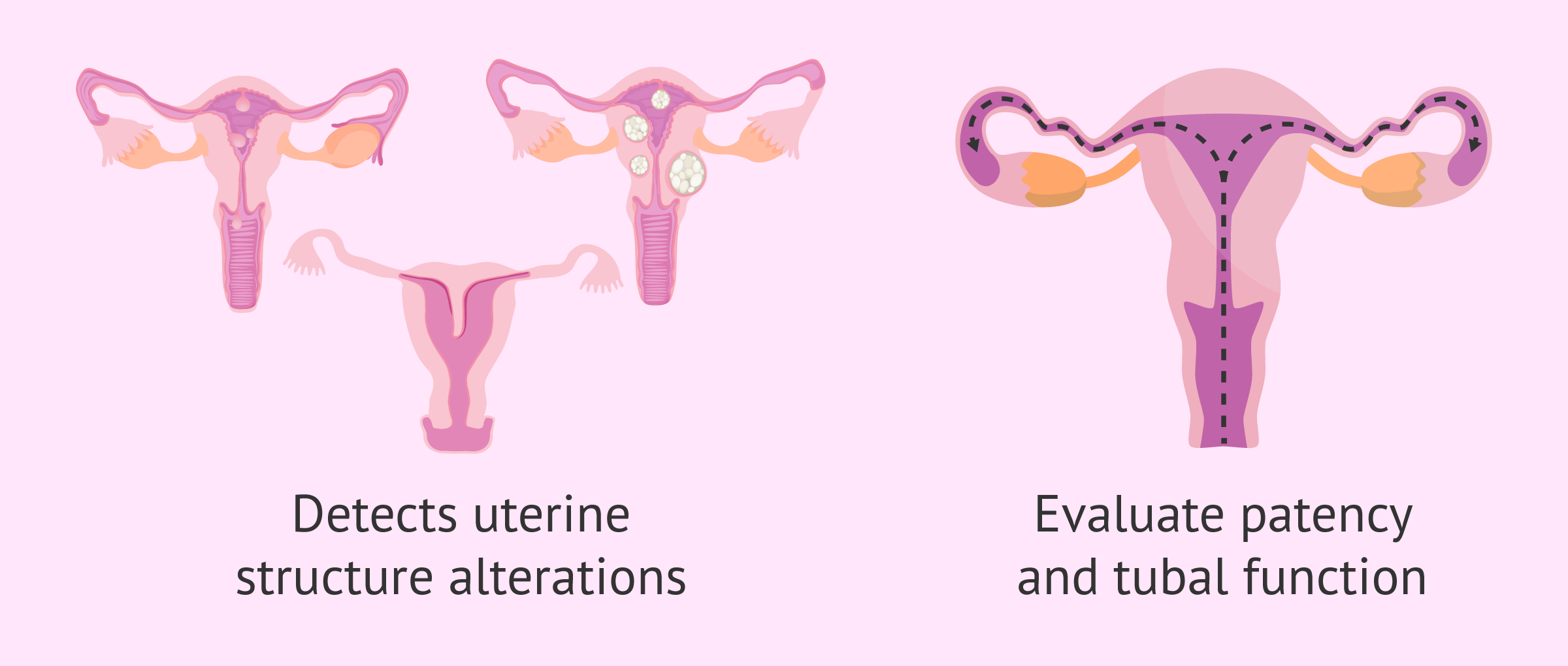
With the results of this diagnostic test it will be possible to know if the woman has any infertility problem due to uterine and/or tubal factor. In addition, HyCoSy is also used to determine which assisted reproduction treatment will be the most appropriate for a woman to achieve pregnancy.
HyCoSy vs HSG
Traditionally, the imaging test of the fallopian tubes has always been hysterosalpingography (HSG), which consists of an x-ray of the uterus and tubes.
For this, an iodinated contrast medium is introduced through the cervix via a catheter and then the radiologist takes images of the abdomen with an X-ray machine.
Clearly, HyCoSy has many advantages over conventional HSG, as it does not use iodinated contrast or X-rays to make the diagnosis. The benefits of HyCoSy are therefore summarized below:
- It is not an invasive technique.
- There is no risk of allergy to radiopaque contrast.
- The woman does not have as much discomfort during the process.
- Its use is simple and fast.
- The images obtained are sharper.
- It can be done at the gynecologist's office.
- The results are obtained instantly.

In conclusion, HyCosy offers a better diagnosis than classic HSG and, in addition, the possible side effects are lower.
How is HyCoSy done?
The HyCoSy procedure is very simple, but it is necessary to take some precautions before the test to minimize possible risks.
Preparation
HyCoSy should be done at the beginning of the menstrual cycle, when the woman has finished menstruation, but before ovulation occurs. With this, the physician ensures that the woman is not pregnant at the time of the test, since the contrast medium could alter the implantation of the embryo.
In general, it is recommended to perform HyCoSy between days 7 and 10 of the menstrual cycle as long as the woman is regular. Otherwise, the physician will determine the best time to do it.

Since no anesthesia is required to perform HyCoSy, the woman may take a painkiller beforehand to avoid any discomfort, although it is generally a painless technique.
Finally, it is not necessary for the woman to fast or have a full bladder.
Procedure
In the following, we will detail step by step how the gynecologist performs the HyCoSy process:
- The woman is placed in the gynecological position on the gurney.
- A speculum is gently placed into the vagina to view the cervix.
- The cervix is cleaned with an antiseptic solution to reduce the risk of infection.
- A flexible catheter is introduced through the cervix into the uterine cavity.
- The vaginal speculum is removed.
- The contrast medium, which will be a physiological saline or galactose solution, is slowly introduced.
- The ultrasound probe is introduced through the vagina to start taking images.
- The contrast medium will fill the uterine cavity and diffuse into the tubes. If the tubes are patent, the medium will eventually be expelled into the abdominal cavity.

Throughout this process, the physician will assess the contour and shape of the uterine cavity, the passage of the contrast medium through the tubes and any possible alterations that may be found.
HyCoSy aftercare
In general, HyCoSy is not a painful technique that requires special care. The woman may feel slight discomfort and cramping during the passage of the contrast, but this disappears at the end of the exam.
The woman can continue to lead a normal life after the test: go to work, drive, eat and drink normally.
It is only necessary to take the precaution of putting on a sanitary napkin or pad because there will be a persistent vaginal discharge for hours. This is the fluid used in the test that leaks from the vagina. It is also normal for this loss to be accompanied by a little blood spotting.

If the woman feels pain after HyCoSy she can take a painkiller and rest for a while, but in general recovery is immediate.
FAQs from users
Are HyCoSy and HyFoSy the same?
Practically yes. The procedure, based on hysterosalpingosonography, is the same and the images are obtained by ultrasound. The only difference is the contrast medium used. While HyCoSy is done with saline or a galactose solution, HyFoSy uses a foam.
Is HyCoSy only useful for viewing the fallopian tubes?
No. HyCoSy allows a comprehensive evaluation of the tubes, uterus, endometrial cavity and pelvis. The main diagnosis is based on the interior of the uterus and tubes to detect obstructions. However, by obtaining the ultrasound images, pelvic structures such as the ovaries can also be seen and a quick evaluation can be made to rule out obvious abnormalities.
Suggested for you
If you are going to have a classic hysterosalpingography instead of a HyCoSy and you want to know what it consists of, we recommend you read the following article: What is hysterosalpingography - Indications and results.
In addition, you can visit the following link if you would like to know other tests for the study of female fertility: What are the fertility tests in women and what do they consist of?
We make a great effort to provide you with the highest quality information.
🙏 Please share this article if you liked it. 💜💜 You help us continue!
References
Bin-Bin Jin, Yan Ma, Xiu-Hua Zhao, Yi-Ling Teng, Shang-Yong Zhu. Operator's Influence on Contrast Agent Intravasation During Hysterosalpingo-Contrast Sonography: Explanation Based on a Physics Model. Int J Gen Med. 2022 Oct 7:15:7709-7718. doi: 10.2147/IJGM.S380917. eCollection 2022 (View)
Chunying Li, Yan Huang, Li Xie, Xin Huang. The diagnostic value of hysterosalpingo-contrast sonography in female infertility of the fallopian tube. Pak J Med Sci. 2023 Jul-Aug;39(4):931-935. doi: 10.12669/pjms.39.4.7462 (View)
Wu-Wu Zheng, Lixia Chen, Shunping Chen, Jian Zhu, Feng Lin, Shihao Xu. Value of ovarian positional assessment on 4D hysterosalpingo-contrast sonography. Med Ultrason. 2022 May 25;24(2):167-173. doi: 10.11152/mu-3209. Epub 2021 Sep 10 (View)
Yu Liu, Ning Zhang, Yanni He, Jiayao Shi, Meijun Zhou, Jingjiao Xu, Hongmei Liu. Spontaneous conception outcome in infertile women after four-dimensional hysterosalpingo-contrast-sonography. BMC Pregnancy Childbirth. 2020 Oct 20;20(1):638. doi: 10.1186/s12884-020-03315-x (View)
Zining Xu, Yaoting Wang, Juan Sun, Shuangxi Chen, Zou Yan, Chen Lin, Jing Shu. Evaluation of tubal patency by hysterosalpingo-contrast Sonography (HyCoSy): Controversies, dilemmas and considerations. Heliyon. 2023 Jun 28;9(7):e17461. doi: 10.1016/j.heliyon.2023.e17461 (View)