What is preeclampsia in pregnancy and why does it occur?
Preeclampsia is a complication of pregnancy that mainly presents with arterial hypertension. This condition can even cause the death of the pregnant woman and/or the fetus in the most severe cases.
In addition, preeclampsia can also be a cause of fetal growth restriction, and in fact, it is one of the most frequent reasons for this.
This gestational disorder usually appears after the 20th week of pregnancy, but rarely occurs after delivery. In any case, it is important to establish a therapeutic option as soon as possible to avoid complications.
The different sections of this article have been assembled into the following table of contents.
Contents
- 1.
- 2.
- 2.1.
- 3.
- 4.
- 4.1.
- 4.2.
- 4.3.
- 5.
- 6.
Definition of preeclampsia
Preeclampsia is a pathology that arises during pregnancy and is mainly characterized by arterial hypertension. In addition, preeclampsia can cause damage to some organs such as the liver or kidney, for example. This gestational complication usually appears after the 20th week of pregnancy.
There are cases, although less frequent, in which the woman has preeclampsia when she delivers the baby. This is known as postpartum preeclampsia.


The incidence of preeclampsia is 3-10% of pregnant women, especially if it is the first pregnancy. In addition, some authors indicate that it is more likely to occur in women of African-American ethnicity.
It is essential to treat preeclampsia as soon as possible to avoid its progression to eclampsia, which would pose a serious danger to the life of both the pregnant woman and her baby.
Etiology of preeclampsia
The exact cause of preeclampsia is not known. Some specialists believe that preeclampsia may be caused by autoimmune disorders, vascular problems, diet or genes.
Risk Factors
Although the cause of preeclampsia is unknown, there are some risk factors. Some of them are listed below:
- Nulliparity, i.e., it is the first pregnancy.
- Women with diseases such as diabetes, hypertension, etc. prior to pregnancy.
- Women suffering from renal insufficiency.
- Multiple pregnancy.
- Women with obesity.
- Family history.
- Preeclampsia in previous pregnancy.
- Antiphospholipid syndrome.
- Preconceptional diabetes mellitus and/or gestational diabetes
- Recurrent urinary tract infection.
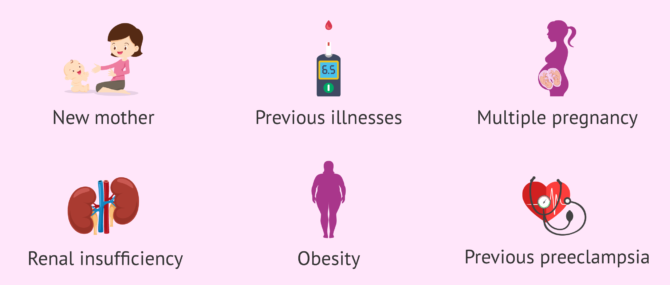
In addition to all these risk factors for preeclampsia, smoking, stress and coagulation disorders also increase the likelihood of preeclampsia occurring during pregnancy.
What are the symptoms of preeclampsia?
The detection of preeclampsia is determined by the appearance of some clear symptoms, although the pregnant woman does not feel sick. Some of the symptoms associated with preeclampsia are the following:
- Increased blood pressure (hypertension).
- Detection of proteins in urine.
- Appearance of edema in the extremities.
- Swelling of hands, feet or face.
- Sudden weight gain.
In more severe cases of preeclampsia, symptoms such as severe headache, nausea, infrequent urination, breathing problems, vision changes, etc. may also appear.

In addition to these main symptoms, preeclampsia can cause a number of disorders in all organs. This gestational complication is associated with a deficit in the blood supply to the maternal organs such as the liver, brain, kidneys or placenta and, therefore, food does not reach the baby properly. Another consequence of preeclampsia is that it can lead to placental abruption.
Treatment
Preeclampsia can be mild or severe. In mild cases of preeclampsia, abnormalities that have occurred during pregnancy usually resolve with delivery.
In any case, a healthy diet, rest and close medical monitoring of both the mother and the fetus may be the most effective treatment for mild preeclampsia. In cases of severe preeclampsia, there may be more symptoms such as mental disorders, epigastric pain, pulmonary edema, sudden weight gain (2 kg per week), visual disturbances or headaches. When this occurs, the solution is usually treatment with antihypertensive drugs or delivery. Hence, on many occasions it is necessary to induce labor, programmed cesarean section or even abortion to avoid serious complications in the mother and fetus.

A correct diagnosis of preeclampsia is complicated, as it is sometimes asymptomatic or produces symptoms that may be common in pregnancy. Therefore, it is important that the doctor detects whether hypertension was already present before pregnancy and that the pregnant woman attends all medical check-ups during pregnancy and especially consults with the specialist for any warning signs.
FAQs from users
What factors increase the risk of preeclampsia in pregnancy?
Preeclampsia is a fairly common gestational complication and, if not treated correctly, can be a cause of perinatal mortality.
The reason for the development of gestational preeclampsia is unknown, but there are some factors that are associated with the development of preeclampsia. Each of them is discussed below:
- First-time mother.
- Family or personal history of preeclampsia.
- Multiple gestation (twins or triplets).
- Obesity.
- Advanced maternal age.
- Black race.
- History of hypertension, diabetes, kidney disease and/or thyroid disease.
- Gestation by ovodonation.
- Inadequate diet.
- Chronic stress.
Therefore, in women with a high probability of developing preeclampsia, it is essential to perform an adequate medical follow-up, as well as to establish an early treatment.
What are the possible complications of pre-eclampsia?
When a woman suffers from pre-eclampsia in pregnancy, it is important to take special care, as complications may develop. Each of these is discussed below:
- Delayed foetal growth
- in pre-eclampsia, the arteries that supply blood to the placenta are affected. As a result, the baby does not get the right amount of blood and oxygen, as well as nutrients.
- Preterm birth
- in cases of severe pre-eclampsia it is necessary to bring the due date forward, but it can also happen that the baby is born before the due date.
- Placental abruption
- this means that the placenta separates from the uterine walls before delivery occurs, leading to a large loss of blood in the woman.
- HELLP syndrome
- is the destruction of erythrocytes or red blood cells accompanied by an increase in liver enzymes and platelet count.
- Eclampsia
- in the most severe cases of pre-eclampsia leads to eclampsia, which leads to seizures.

Is aspirin recommended for preeclampsia?
Aspirin or acetylsalicylic acid is not recommended during pregnancy. However, it is true that specialists sometimes advise taking small amounts of aspirin in women at risk of developing preeclampsia, as well as in pregnant women with recurrent miscarriages or coagulation disorders.
Suggested for you
As mentioned above, preeclampsia is a gestational complication, but it is not the only one. You can learn more about some pregnancy complications in the following article: What are the most common pregnancy complications?
We make a great effort to provide you with the highest quality information.
🙏 Please share this article if you liked it. 💜💜 You help us continue!
References
Anouk Bokslag, Mirjam van Weissenbruch, Ben Willem Mol, Christianne J M de Groot. Preeclampsia; short and long-term consequences for mother and neonate. Early Hum Dev. 2016 Nov;102:47-50. doi: 10.1016/j.earlhumdev.2016.09.007 (View)
Baha M Sibai, Caroline L Stella. Diagnosis and management of atypical preeclampsia-eclampsia. Am J Obstet Gynecol. 2009 May;200(5):481.e1-7. doi: 10.1016/j.ajog.2008.07.048.
Cararach V y Botet F. Preeclampsia. Eclampsia y síndrome HELLP. Institut Clínic de Ginecologia, Obstetrícia i Neonatologia. Hospital Clínic de Barcelona.
Margaret Olutayo Alese, Jagidesa Moodley, Thajasvarie Naicker. Preeclampsia and HELLP syndrome, the role of the liver. J Matern Fetal Neonatal Med. 2021 Jan;34(1):117-123.
Marwan Ma'ayeh, Maged M Costantine. Prevention of preeclampsia. Semin Fetal Neonatal Med. 2020 Oct;25(5):101123. doi: 10.1016/j.siny.2020.101123 (View)
Sarosh Rana, Elizabeth Lemoine, Joey P Granger, S Ananth Karumanchi. Preeclampsia: Pathophysiology, Challenges, and Perspectives. Circ Res. 2019 Mar 29;124(7):1094-1112. doi: 10.1161/CIRCRESAHA.118.313276 (View)