Preservation of Fertility in Men with Cancer
The survival of children and men with cancer has increased in recent years thanks to the most effective therapies being discovered to combat this terrible disease.
However, chemotherapy, radiotherapy, and surgery also have the disadvantage of affecting the stem cells of the testicles and compromising male fertility.
That is why it is essential to be well-informed about fertility preservation options, such as semen freezing, before starting cancer treatment.
The different sections of this article have been assembled into the following table of contents.
Contents
- 1.
- 2.
- 2.1.
- 2.2.
- 3.
- 4.
- 4.1.
- 4.2.
- 4.3.
- 4.4.
- 5.
- 6.
Effects of cancer therapies
The cure for cancer is the main objective of all professionals and the anti-cancer treatments they use for this, even though they have to assume quite hard side effects to achieve it.
One of them is infertility. Many of the patients undergoing radiation and/or chemotherapy will not be able to have children in the future despite having survived cancer.
Male sterility due to a testicular factor after cancer may be temporary or permanent, but there is no way to know how many years can pass before the man recovers sperm production.
The effect and severity of cancer therapies on male fertility depend on several factors, such as the type of tumor, age, the radiation dose, etc. For example, the most aggressive cancers for fertility are testicular cancer, prostate cancer, leukemia, and Hodking's lymphoma.


As for the types of cancer treatment, they affect fertility in the following ways:
- Chemotherapy
- chemotherapy drugs are used to eliminate cells in the body that are in division. Tumor cells divide rapidly, but there are also other healthy cells that can be found in the division, such as spermatogonia (stem cells from the testicle). Alkylating agents such as mechlorethamine or procarbazine are some of the anti-tumor drugs that most affect the male reproductive system.
- Radiotherapy
- radiation directed at the pelvic area can also affect the testicles and destroy the stem cell population, especially if high energy (24 Gy) rays are used.
- Surgery
- when removal of one or both testicles is required (orchiectomy). With a testicle, it would still be possible to have children if the testicular function is restored, but without both, it would not be possible.


Get more information about this topic here: What Are the Effects of Cancer on Fertility?
How to preserve male fertility?
The American Society of Clinical Oncology (ASCO) and the American Society for Reproductive Medicine (ASRM) recommend that all patients undergoing cancer treatment talk first with a specialist about the effects it may have on their fertility.
These patients should also be informed about options for preserving their fertility, which must be compatible with cancer treatments.

In no case shall the life of the male be endangered by the desire to preserve his fertility.
In men
Sperm freezing is the best and easiest option for preserving fertility in all adult men, whether you are going to receive an antitumor treatment or for other reasons.
In order to preserve the semen, it is only necessary to obtain a sample by masturbation. The laboratory staff will then process it correctly and freeze it in liquid nitrogen. This sample will eventually be stored in a semen bank until its use is required.

One of the problems that can arise is that the male already presents subfertility initially due to a testicular tumor, for example.
Semen freezing should be done before cancer treatment to avoid genetic damage to spermatozoa and, if time permits, it is advisable to freeze at least three samples with a 48-hour interval.
Sometimes, cases of oligospermia and azoospermia may be diagnosed before undergoing chemotherapy or radiation therapy, so a testicle or epididymis biopsy may be necessary to obtain the sperm sample.

Even if few sperm are obtained, the man could still be a father thanks to assisted reproduction treatments such as in vitro fertilization (IVF) with intracytoplasmic sperm injection (ICSI).
In children
Semen freezing is only possible for males who have reached puberty, which usually happens around age 13. Therefore, children with cancer will have a harder time preserving their fertility, as they will not be able to obtain a semen sample by masturbation.
In some cases, it is possible to use electroejaculation with general anesthesia or to make a stimulation by the vibration of the penis to obtain the sperm.
On the other hand, there are some strategies to preserve fertility in children who are in the experimental phase:
- Freezing of immature testicular tissue and subsequent reimplantation.
- Differentiation of spermatozoa in vitro from cryopreserved stem cells
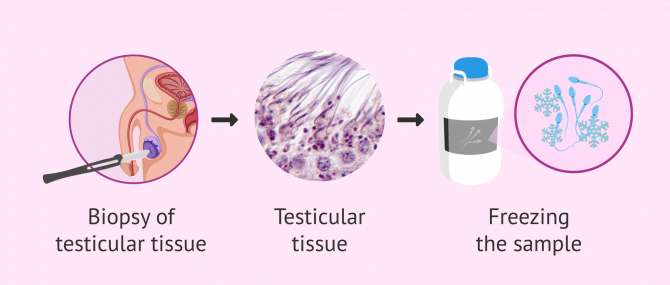
In the case of freezing testicular tissue, the process is similar to that of freezing ovarian tissue. Small fragments of the cortex of the seminiferous tubules are extracted, as this is where the germ cells of the sperm in the testicle are found.
Being a father without preserving fertility
Despite all efforts to make society aware of the importance of preserving fertility, there are still many men who today cannot become fathers after overcoming cancer.
As we have said, this infertility can be temporary or permanent depending on the aggressiveness of the chemotherapy or radiotherapy.
In general, men who have not preserved fertility prior to cancer treatment may encounter any of these 3 situations:
- Recovery of spermatogenesis
- these men are able to regain normal testicular function and may therefore result in a natural pregnancy. Unfortunately, this only happens in 20-30% of cases.
- Altered semen quality
- there is production of sperm but these have altered their concentration, mobility or morphology. There may also be DNA damage, so it is recommended that all necessary diagnostic tests be done before attempting a pregnancy. These men can have children thanks to assisted reproduction techniques.
- Total absence of spermatozoa
- these men are left in a situation of azoospermia. His only option for parenting will be to resort to semen donation.

Related topic: How does Cancer affect Fertility in Men and Women?
FAQs from users
Is it possible to preserve fertility in children with cancer?
Today, preservation of fertility is possible if the child has already reached sexual maturity. Once children have reached sexual maturity, it is possible to obtain ejaculate with sperm. In this way, the sample obtained could be frozen to be used in future assisted reproduction treatments.
Sexual maturity is usually attained around 13 years of age.
Can I have children after chemotherapy treatment?
Yes, but depending on whether the semen has been cryopreserved or not, it will be more or less complicated to get pregnant.
Those men who have a good sample of frozen semen may have children through artificial insemination or in vitro fertilization treatment as the case may be.

On the other hand, if the patient did not have frozen semen, it will be necessary to confirm whether or not they have testicular function. Occasionally, it is possible to recover sperm through microsurgery or puncture of the testicle.
How do you freeze sperm?
Semen cryopreservation, also known as male fertility preservation, consists of keeping male gametes (sperm) stored at low temperature for long periods of time without altering their quality.
These sperm can be used in the future to achieve a pregnancy through assisted reproduction treatment, either artificial insemination (AI) or in vitro fertilization (IVF).
How much does sperm freezing cost?
The price of freezing a semen sample ranges from $250 to $1,300. However, the costs may vary depending on the fertility clinic where it is carried out. In addition, the cost of sperm freezing will also depend on how long the semen will be stored and what's included in the initial budget.

The initial budget often includes an initial deposit. Afterwards, a renewal of the storage is necessary which can add up another $270-500 per year.
Suggested for you
As we have discussed, cancer treatments can affect fertility in a number of ways. If you're interested in learning more about this, you can read on in the following article: How Does Cancer Affect Fertility in Men and Women?
Likewise, if you want to keep learning about more options for preserving fertility in both men and women, don't miss the next post: Preserving fertility: freezing eggs and sperm.
We make a great effort to provide you with the highest quality information.
🙏 Please share this article if you liked it. 💜💜 You help us continue!
References
Garrido-Colino C, Lassaletta A, Vazquez MÁ, Echevarria A, Gutierrez I, Andión M, Berlanga P; en representación del Comité de Adolescentes de la SEHOP. Situación de la preservación de fertilidad en pacientes con cáncer en nuestro medio: grado de conocimiento, información e implicación de los profesionales. An Pediatr (Barc). 2017 Jul;87(1):3-8.
Holoch P, Wald M. Current options for preservation of fertility in the male. Fertil Steril. 2011;96(2):286-90.