
The egg, once fertilized, starts developing and migrates to the uterine cavity where it implants into the endometrium, and a new pregnancy begins.
The woman usually has no symptoms during the fertilization of the egg in these first days of gestation. However, the implantation of the embryo can give rise to some symptoms, including implantation bleeding.
However, not all women experience implantation spotting. Therefore, the absence of bleeding does not necessarily mean that the woman is not pregnant.
Provided below is an index with the 7 points we are going to expand on in this article.
- 1.
- 2.
- 2.1.
- 2.2.
- 3.
- 4.
- 4.1.
- 4.2.
- 4.3.
- 4.4.
- 4.5.
- 4.6.
- 4.7.
- 4.8.
- 5.
- 6.
- 7.
Stages of the embryo implantation process
Egg implantation is the process by which the embryo attaches to the endometrium, continuing its development and giving rise to an evolving pregnancy. Thanks to implantation, the embyro can now oxygen and nutrients it needs from the mother via the blood during the following months of gestation.
Implantation begins on the seventh or eighth day of embryonic development, that is to say after the sperm has fertilized the egg, and can last for several days.
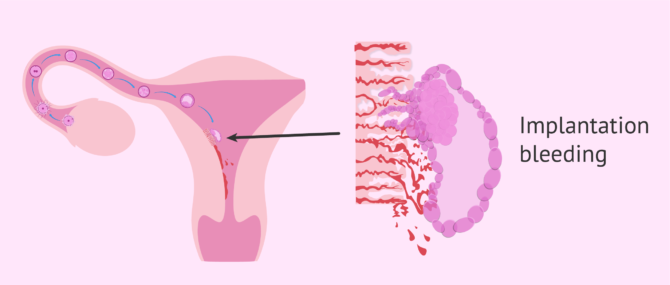
For this embryo implantation to take place, the mother's endometrium must be receptive and the embryo must be in the blastocyst stage. There must be total synchrony between the two events.
During the implantation process, the blastocyst invades the endometrium and breaks its blood vessels. New ones can then form to allow the exchange of nutrients from the maternal blood via the placenta and the umbilical cord. The rupture of these small endometrial vessels causes implantation bleeding to occur.
Embryo implantation takes place in the fourth week of pregnancy, at which time beta-hCG hormone production begins and a pregnancy test may give a positive result.
From this moment, levels of pregnancy-related hormones rise (beta-hCG and progesterone), which are responsible for the typical pregnancy symptoms. Most women don't usually notice symptoms until around the fifth or sixth week of gestation, although there are women who may experience them earlier.
To learn more about the steps involved in embryo implantation, we recommend visiting this guide: Embryo implantation: process and stages.
What does implantation bleeding look like?
Implantation bleeding consists of light vaginal bleeding or spotting that occurs a few days after implantation.
The duration of this bleeding depends on the woman. Generally, it is short-lived, although it may last several days or a week with intermittent spotting.
Implantation bleeding can be a symptom of pregnancy, as it occurs when the embryo penetrates and attaches to the endometrium, resulting in a developing gestation.
It should be noted that implantation bleeding does not always occur in pregnancy. It is more common for a woman not have any bleeding at all when she becomes pregnant.
When does implantation bleeding occur?
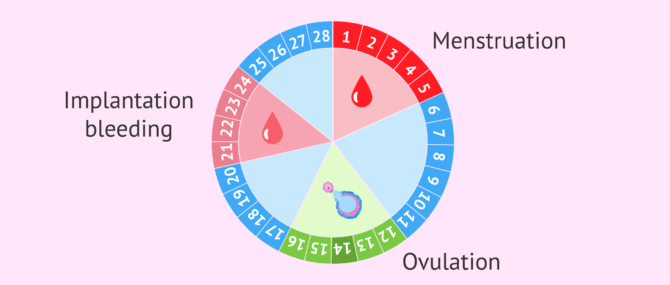
If we assume a 28-day menstrual cycle, where ovulation occurs in the middle of the cycle, it is common for implantation bleeding to occur about 7 to 10 days after ovulation.
In other words, implantation bleeding usually occurs on around days 21-24 of the menstrual cycle, just before the period. Therefore, it is easy to confuse it with an early period, especially in those with irregular cycles.
Only women actively looking for pregnancy, who keep a strict control of their menstrual cycle, are able to identify this implantation bleeding as a sign of pregnancy.
Having said this, for women who are in the beta standby period after an assisted reproduction treatment, it is important to point out that implantation bleeding does not occur in most cases. Therefore, not experiencing spotting during beta standby does not necessarily mean that the treatment did not work.
To reliably check whether a woman has achieved pregnancy, it is necessary to do a urine test or beta-hCG blood test at the right time. If you want to know more information in detail about this matter, we recommend continuing your reading here: When to do a pregnancy test.
Implantation bleeding or period?
Since implantation bleeding is vaginal bleeding that occurs at the end of the menstrual cycle, it is easy to confuse with menstruation as explained in the previous section.
However, implantation bleeding has some characteristics that allow us to recognize it:
- Lighter spotting than a regular period, and of a lighter consistency.
- The color can be pink, brown or reddish, although it is not usually as intense in colour as regular period blood.
- It can last for as little as a few hours, or even as long as a few days, as light or moderate, intermittent spotting.
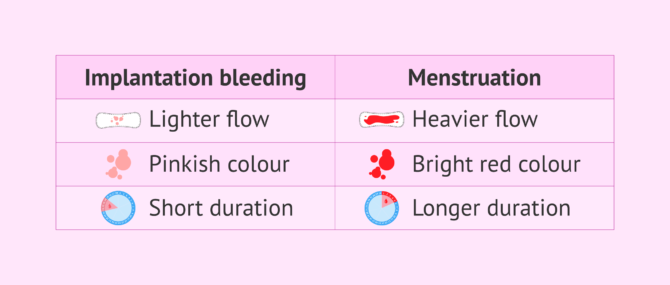
Taking these characteristics into account, it is possible to differentiate implantation bleeding from an early start of menstruation.
Other common signs of embryo implantation
In addition to the implantation bleeding that we have discussed, there are other symptoms of pregnancy that may appear along with this spotting. These symptoms also help to determine whether it is really embryo implantation or menstruation.
However, it is important to keep in mind that some pregnancy symptoms are similar to premenstrual symptoms and therefore may cause more doubt and confusion.
The following are some of the typical symptoms of pregnancy:
- Late period
- Cramping over 1 or 2 days, similar to period pain.
- Slight swelling of the breasts, especially around the areola and the nipple.
- Digestive disturbances such as diarrhea, constipation or heartburn.
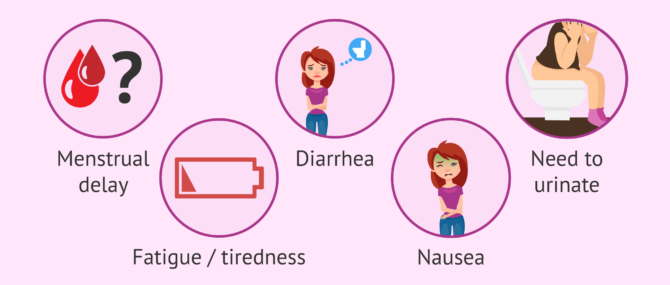
- Constant urge to urinate.
- Fatigue and tiredness.
- Nausea or even vomiting, especially after waking up.
- Aversion to some foods, tobacco and certain smells.
- First food cravings, and more meals but with less quantity of food.

It is also possible for a woman to have these implantation symptoms without the characteristic bleeding described in this post. Every woman is different and there is a great variability in the symptoms that are noticed throughout pregnancy.
Excessive monitoring of any type of sign or change in the body, together with the enormous desire to be a mother and the fear of not achieving it, can cause the woman herself to provoke the symptoms of pregnancy without being pregnant.
Therefore, the best thing to do when planning pregnancy and trying for a baby is to be calm. Try to relax with a pleasant activities and avoid analyzing every symptom obsessively!
FAQs from users
How do I distinguish implantaton bleeding from my period?
Post-implantation bleeding usually occurs a few days after the embryo transfer and is usually vaginal bleeding of a smaller amount than a menstrual period.
In case of unsuccessful treatment, menstruation occurs at least one week after the embryo transfer and the amount of bleeding is greater.
What are the symptoms of egg fertilization?
It is important to point out here that egg fertilization is not the same as embryo implantation.
Fertilization is the process where the sperm unites with the egg to form a zygote, which will begin its development and form the embryo. Subsequently, the embryo, now divided into several cells, will implant in the uterine cavity and start the pregnancy.
Therefore, fertilization does not cause any symptoms. The union of the egg and the sperm does not cause discomfort or pain. In contrast, embryo implantation can cause some symptoms, such as implantation bleeding.
When is the implantation of the fertilized egg noticeable?
The most characteristic symptom of embryonic implantation is usually brief, occasional bleeding—that is, implantation bleeding. However, this spotting doesn't always occur, as it only happens in approximately one-third of pregnant women.
Additionally, the woman may also experience discomfort such as breast swelling, fatigue, increased frequency of urination, etc. Even so, these symptoms are very general and can be confused with premenstrual symptoms. Therefore, the only way to confirm if a pregnancy has occurred is by taking a pregnancy test after a missed menstrual period.
Does egg implantation hurt?
No. The implantation of the fertilized egg, which is now an embryo, does not cause pain. However, there may be some symptoms and discomfort, similar to what a woman might feel when her menstrual period is approaching.
Therefore, if the woman notices severe pain, or experiences other symptoms, it would be advisable to consult with her specialist so they can perform an assessment and determine the possible causes.
What does implantation bleeding look like?
The most common color for implantation spotting is pink or brownish, although the characteristics of this bleeding can vary from one woman to another.
However, the characteristics of implantation bleeding are different from menstruation, as it is usually not bright red and, furthermore, it lasts for a shorter time.
Implantation bleeding can be pink, a more reddish color, or even brown, depending on the woman. Generally, the color is not as intense as menstrual bleeding.
How long does implantation bleeding last?
Implantation bleeding has different characteristics than a menstrual period. Because of this, implantation spotting is usually bleeding of shorter duration, lasting around a few hours or appearing intermittently for a couple of days or three. However, it is not common for it to last longer.
When is it advisable to do a pregnancy test if there is implantation bleeding?
Implantation spotting most commonly appears in the days leading up to the menstrual period. Therefore, the ideal time to take a pregnancy test would be when a period is missed or when at least 15 days have passed since sexual intercourse. At that point, the result of the pregnancy test would be reliable.
Conversely, if the pregnancy test is performed too early, the result could be inaccurate. The pregnancy test detects the beta-hCG hormone, which is secreted by the embryo after implantation. If the test is done too soon, the beta-hCG levels may not have risen sufficiently, resulting in a false negative.
Is implantation bleeding common after IVF-ICSI?
This depends on the individual woman. As with natural conception, not all women who undergo IVF treatment experience embryo implantation bleeding.
When the embryo is transferred into the uterus, some women experience slight implantation spotting. However, other women have no bleeding at all. This is why the presence or absence of implantation bleeding does not mean that pregnancy has been achieved or not.
Recommended reading
Embryo implantation is a complex process regulated by both maternal and embryonic factors. If you want to know all the details in each of the stages, you can go to the following post: What is embryo implantation?
Apart from implantation bleeding, other bleeding can occur during pregnancy that may cause for stress and concern on the part of the mother. For more information on this topic, we recommend that you continue reading here: Is bleeding in pregnancy normal?
We make a great effort to provide you with the highest quality information.
🙏 Please share this article if you liked it. 💜💜 You help us continue!
References
Khaled M Zohni, Itai Gat, Clifford Librach. Recurrent implantation failure: a comprehensive review. Minerva Ginecol. 2016 Dec;68(6):653-67. Epub 2016 Mar 16.
Michael R McGowen, Offer Erez, Roberto Romero, Derek E Wildman. The evolution of embryo implantation. Int J Dev Biol. 2014;58(2-4):155-61. doi: 10.1387/ijdb.140020dw (view)
Michael J Soares. Embryo implantation - coordination of maternal and embryonic adaptations. Int J Dev Biol. 2014;58(2-4):71-4. doi: 10.1387/ijdb.140086ms (view)
FAQs from users: 'How do I distinguish implantaton bleeding from my period?', 'What are the symptoms of egg fertilization?', 'When is the implantation of the fertilized egg noticeable?', 'Does implantation bleeding have clots?', 'Does egg implantation hurt?', 'What does implantation bleeding look like?', 'Can implantation bleeding occur the day of your expected period?', 'How long does implantation bleeding last?', 'Is implantation bleeding common after IVF-ICSI?', 'When is it advisable to do a pregnancy test if there is implantation bleeding?', 'Does everyone get symptoms of implantation?', 'Can you notice symptoms as early as after sperm implantation?' and 'Does embryo implantation make you tired?'.
Authors and contributors


More information about Michelle Lorraine Embleton


Hello. I need help. I have a 2-embryo blast transfer done 11 days ago. I did an urine pregnancy test this morning and it’s negative, but I have all kind of symptoms: nauseas, pain in my leg, lower back pain, my boobs are really sor…. Besides, I have headache, bloating, and everyday I feel a lot of cramps similar to my period cramps.
I wonder if this is normal or if I could be pregnant… My blood test is on Oct 14.
Thanks for your help.
Hello,
You can find the answer to your query in our forum. Click here: http://www.invitra.com/forums/topic/embryo-transfer-symptoms-before-positive-outcome/#post-7280
Thanks for getting involved
HI! I am very new at this! I just had a 3-day, category C embryo transfer done on Feb 07/16 so I’m on day 9 after transfer. I was very uncomfortable for a few days after since I got hyperstimulated ovaries. So I’m not sure how to interpret my symptoms the first week. However, I did get very stuffy nose for 3 days and it stopped, massive headaches that last for less then a minute and go, I’m very thirsty and go to the bathroom more then usual. On day 7 and 8 during the day, I experienced period like cramps and I was very scared as I thought my period was going to show up any time, but this also stopped. My breasts feel a little tender but not too bad. I guess my questions is: is it a bad sign that I had more symptoms the first week and on and off cramps, but less symptoms on the second week? Thank you.
Hello Martha,
The answer to your question is yes, because the symptoms you had are likely to be due to ovulation induction drugs taken for ovarian hyperstimulation.
I hope I have been able to help,
Best wishes
So, yes you think is a bad sign and that implantation may have not occurred?
Hello again Martha,
No, there is no reason as to why it may be a bad sign. Not every woman experiences post transfer symptoms, without meaning that the treatment has been unsuccessful. In fact, as you said in your previous comment, you still have some symptoms, which may be due to embryo implantation. However, they may be an indicator that your period is about to show up soon as well. Be it as it may, we can’t be sure up until day 15 post embryo transfer.
I hope I have been able to help again and you share your outcome with all of us,
Best wishes
Hi…
I’m new to IVF. I’m 41 yrs old. Cervical scan shows I’m in a good condition. I just had an embryo transferred on 6/4/2016 (day 3) and today 10/4/2016 would be day 7 of the procedure, since that I only felt very mild hotness at my lower abdomen. But today no more hot feeling and no pregnancy symptoms. FYI, I had 3 embryos transferred:
1) 8-cell grade 1
2) 7-cell grade 2
3) 4-cell stop developing
Question:
1) Is this the normal process of implantation or its too early to be worried?
2) Based on the info on google, today implantation is completed and cells that will eventually become the placenta and fetal cells begin to develop.
3) What are the chances of having a pregnancy?
Hello Zara zia,
judging by the quality of the embryos you had transferred, embryos 1) and 2) are of high quality and therefore likely to implant, whereas embryo No. 3) is highly unlikely to achieve so. Anyhow, your prognosis is good, because embryos 1) and 2) are high quality embryos. However, I’m sorry I cannot give you a precise figure as it depends on other factors such as age, previous cycles (if any), etc.
Best of luck!
Hey Sandra,
Thank you for your reply.
Furthermore, I have stress these few days. Had an argument with husband and just knew that sister was diagnosed with cancer.
1) Is this will effect the implantation?
2) Today i had mild cramping and bloated same like when period. Is this good or bad symptom.
3) If I had ET on 6.4.2016 means that today would be my 8 day developing the fetal?
4) Should I bed rest? But I still walk over dinning and kitchen
Please help.
Hi I did 5d blastocyst transfer on May 12. I’m on my 5th day. I did a hpt and got a negative. Is it too soon to test? I don’t have any symptoms or anything ?
Dear Heidi,
Yes, it is still too early to test. Taking into account that it was a blastocyst embryo transfer, at least 10 days are necessary for hCG levels to be detectable with a HPT in case implantation has taken place.
On the other hand, the fact that you are not having any symptoms or signs does not mean anything. Some women experience them, and others don’t. It does not translate into a failed cycle or anything similar, so do not worry and, most importantly, try not to become obsessed with the final outcome.
I hope I have been able to help,
Best of lucks!
Hi All,
Need help from you people,
I had 3days transfer on 15th of July and have HPT in next few days.
I have symptoms as below:
1. From 6th -10th days (after transfer) I have cramps in both legs, sometimes in right, sometimes in left leg (Today 12th day still have cycle-like pain in legs).
2. Had warm body temperature for some days but no fever
3. For some days had morning headache for 5-10 mins while waking up.
4. Had backache for 3-4 days but not painful.
5. Sometimes have pain in abdomen just for few mins
6. Have the on and off pain in abdomen for some time
I don’t know what this means… if you people have any info please let me know.
Thanks
Dear angel,
3 days after embryo transfer is still too early to throw any conclusions on whether these are early pregnancy symptoms or not. This set of symptoms you’ve described are very likely due to the medications you’ve been taking and the transfer itself. My advice is that you continue with your normal lifestyle, not becoming obsessed with noticing pregnancy symptoms. Stress doesn’t help in these situations.
Best wishes!