What Is Unexplained Infertility? – Causes, Diagnosis & Treatment
Infertility can have a very diverse origin: 30% is due to female causes, another 30% to male causes and 20% has mixed causes, that is, both members of the couple have alterations.
The remaining 20%, on the other hand, has an unknown origin. This means that after having done all the usual diagnostic tests, the results are normal and it is unknown what may be altering the female or male reproductive system to prevent pregnancy.
Given this situation of infertility of unknown origin, it will be important to assess the woman's age to decide whether it is better to opt for artificial insemination (AI) or in vitro fertilization (IVF).
The different sections of this article have been assembled into the following table of contents.
Contents
- 1.
- 2.
- 3.
- 4.
- 4.1.
- 4.2.
- 4.3.
- 4.4.
- 5.
- 6.
- 6.1.
- 6.2.
- 6.3.
- 6.4.
- 7.
- 8.
What is infertility of unknown origin or EOD?
Infertility without apparent cause or of unknown origin refers to those situations in which, after a female and male fertility study, the reason for not achieving pregnancy has not yet been found.
Approximately 20% of infertility cases in Spain are of unknown origin. This situation means more uncertainty for patients as they do not know what they can do and how they can achieve pregnancy.


However, the good news is that, thanks to assisted reproduction treatments, patients diagnosed with EOD can have a baby. It is usual to start with a simple assisted reproductive technique and gradually progress to more complex techniques if a positive result is not obtained. As a last resort, donor gametes (eggs and sperm) will be used.
Diagnosis
Unexplained infertility is also known as idiopathic sterility.
It should be noted that not knowing the reasons why a couple does not get pregnant does not mean that there is no specific cause. All cases of infertility have a cause, but it is sometimes difficult to detect.
For all these reasons, a couple is considered to have unexplained infertility when the following conditions are met:
- Menstrual cycles are regular.
- Hormone analysis on days 3-5 of the menstrual cycle is normal.
- The antimüllerian hormone is within normal reference limits.
- Hysterosalpingography indicates that the fallopian tubes are permeable.
- Ultrasounds indicate that the anatomy of the uterus is regular, without presenting fibroids or polyps.
- The antral follicle count (AFR) by ultrasound is greater than 5 and the endometrial line is regular and homogeneous.
- All parameters of the seminogram are within the reference values.
- Sexual intercourse occurs frequently, particularly near the time of ovulation.
- The couple has been trying to conceive for at least a year without success.

In addition to all the diagnostic tests discussed so far, there are additional tests that may be able to find the cause of infertility. However, it is sometimes preferable to carry out fertility treatment before continuing blind testing.
It can also happen that, even if a diagnosis of unexplained infertility is made at first, the exact cause of infertility is identified after repeated failures in assisted reproduction treatments, spontaneous abortions or by performing more complementary tests.
Causes
Since we are talking about infertility of unknown origin, it is difficult to explain the real reasons why a couple does not achieve pregnancy.
However, experience in assisted reproduction treatments has detected some alterations that could be the cause of this difficulty in conceiving. These are explained below:
- Genetic alterations in spermatozoa
- spermatozoa with errors in their genetic sequence can lead to fertilization failures or poor quality embryos that cannot lead to a viable pregnancy. In order to detect these anomalies, genetic tests would have to be carried out on the male's semen, such as a DNA fragmentation test.
- Chromosomal changes in the egg
- the number of aneuploidies or genetic mutations in a woman's eggs increases with age. Even if the woman has normal ovulatory cycles, it is possible that the oocyte quality is affected and they are not capable of giving rise to embryos that implant and develop normally.
- Alterations in the embryo
- by fertilizing the eggs with the sperm in the laboratory, it is possible to observe the morphology of the embryos and their development. Embryos with asymmetric cells, fragmentation, multiple nuclei or slow-growing embryos are considered to be of poor quality and therefore more likely to become blocked and lead to implantation failures or biochemical abortions.
- Implantation failures
- for the embryo to adhere to the uterine wall and begin its development, the endometrium must be receptive and there must be perfect synchronisation between embryo and endometrium. A displaced implantation window could result in implantation failure and inability to achieve pregnancy.

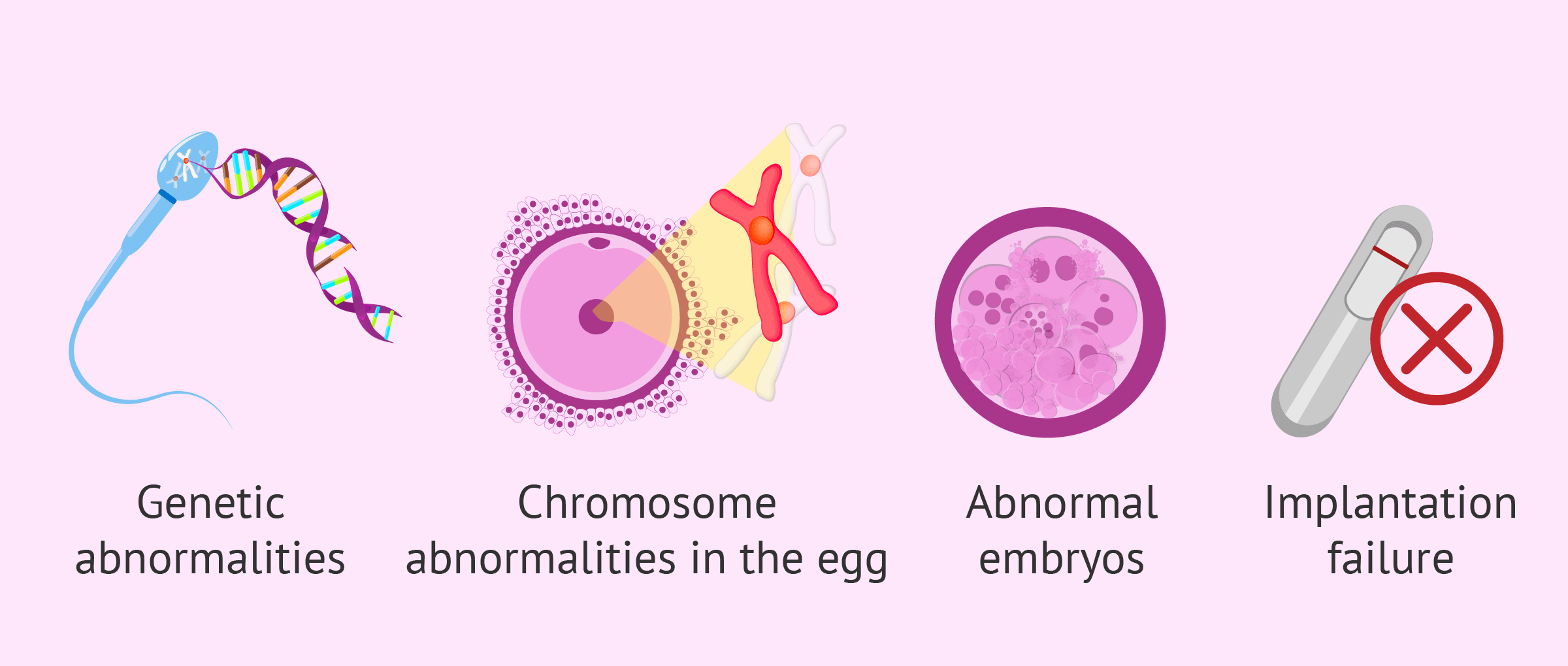
All of these alterations can lead to infertility of unknown primary or secondary origin, i.e. the couple may have had a previous child in the past and now may not be able to conceive a second baby.
It should be noted that a woman's age is also a very important factor that must be taken into account when looking for a cause of infertility. From the age of 35, the probability of achieving a natural pregnancy decreases considerably due to the aging of the ovaries.
Treatment of unexplained infertility
Appropriate treatment to address unexplained infertility will depend on the woman's age.
In general, if the couple is young and the tests do not indicate anything relevant, the specialists resort to an empirical and staggered treatment, that is to say, from the simplest to the most complicated techniques.
On the other hand, if the woman is already of advanced maternal age, specialists may indicate a direct move to highly complex treatment, such as in vitro fertilization (IVF).
Whether you need to undergo IUI or IVF to become a mother, we recommend that you get your Fertility Report now. In 3 simple steps, it will show you a list of clinics that fit your preferences and meet our strict quality criteria. Moreover, you will receive a report via email with useful tips to visit a fertility clinic for the first time.
Now, let's take a step-by-step look at the approach to achieving pregnancy in a young couple with unexplained infertility.
Natural treatment
Sometimes, small changes in the couple's lifestyle can solve this infertility problem. Here are a few important tips when looking for pregnancy:
- Adapt healthy eating habits Above all, it is very important to consume fruits and vegetables that provide all the vitamins, minerals and antioxidants necessary for good reproductive health.
- Eliminate toxic substances such as tobacco and reduce the consumption of alcohol and caffeine.
- Doing moderate exercise, as it also helps to reduce the level of stress and anxiety that often causes the search for pregnancy.
- Lose weight if you are overweight or obese.
- Keep track of fertile days and have sex every other day. In this way, sexual abstinence contributes to optimal seminal quality.

It is possible that, in addition to all of this, the specialist may instruct the couple to perform several cycles of timed intercourse. The follicular phase of the menstrual cycle is controlled by ultrasound and the couple is instructed to have sexual intercourse just on the day of ovulation.
You can read more about this here: What is timed intercourse?
Artificial insemination
Artificial insemination (AI) will be the next indicated treatment in case of not achieving pregnancy with the programmed sexual relations.
It may also be decided to try pregnancy directly with AI if the couple has been looking for pregnancy naturally for some time without success.
Artificial insemination consists of making a slight ovarian stimulation to the woman to favor the development of one or two follicles in the ovary. Ovulation is then induced and the semen of the able-bodied male is deposited inside the uterus.

AI is a very simple technique and therefore it is recommended to do a maximum of 4 cycles before moving on to the next treatment. The likelihood of pregnancy increases as more inseminations are done, but once the fourth AI is reached, studies show that the success rate does no longer increase.
Read more here: What is AI? Process, Cost & Types.
In vitro fertilization
When previous AI treatments have failed or if the woman is more than 36 years old, the treatment indicated to achieve pregnancy will be IVF.
IVF has a much higher success rate than previous treatments and can also provide more information about possible causes of infertility that have not been detected.

With IVF, a woman's eggs and embryos can be viewed under a microscope after fertilization has taken place. In this way, it is possible to classify them according to established quality parameters.
The best quality embryo will be chosen to transfer it to the mother's uterus and try to achieve gestation.
Complementary tests
If after all the procedures we have mentioned, pregnancy still does not occur, the specialist will have to ask the couple to continue doing more tests or techniques of greater complexity.
- Karyotype
- consists of a genetic test to see the structure and number of chromosomes, and detect possible alterations such as duplications, inversions, etc..
- Preimplantation genetic diagnosis
- is a genetic test done on embryos during the course of IVF. In this way, genetically healthy embryos are identified for transfer, while embryos with genetic anomalies are discarded.
- ERA test
- is a test to study the receptivity of the endometrium in order to determine the best time to perform the embryo transfer.
- Thrombophilia tests
- blood clotting problems can lead to repeated implantation failures or recurrent abortions that are not identified until specific thrombophilia tests are done.
- Gametes donation
- when the cause of infertility has not been found or when neither treatment has worked, it is possible to change one or both gametes (eggs and sperm) to try to achieve pregnancy.

Unexplained infertility is one of the most distressing diagnoses for couples who have been trying to get pregnant for years.
Not knowing what's going on, who of the two has the problem, not being able to come up with a solution, etc. further contributes to the desperation of these couples and, on many occasions, they will need psychological assistance.
Video on Unexplained Infertility
Antonio Forgiarini, gynaecologist at Next Fertiliy Valencia, tells us all the details about infertility of unknown origin in this video. As the doctor tells us:
Well, unexplained sterility I think it's 25%-30% more or less of all the sterility causes. And it's when we don't know, initially, the cause of the sterility.

FAQs from users
How is unexplained infertility diagnosed?
We speak of Infertility of Unknown Origin (DOE) when after the basic study of infertility there is no cause that justifies reproductive failure. The basic infertility study does not attempt to analyse each of the events or organs that determine fertility. It is not a question of identifying what does not work in a person, but of establishing whether the minimum conditions are in place to be able to start a couple's reproduction treatment. In other words, it is a question of establishing a therapeutic strategy. The basic studies are therefore aimed at determining whether there is:
- Adequate ovarian reserve in the woman
- Affectation of seminal quality in men
- Tubal alteration
- Uterine factor
Which fertility treatment is recommended in cases of unexplained infertility?
It depends on the age of the patient. Unknown sterility implies that a couple has tried to get pregnant for at least 1 year without results and has done a basic infertility study which results in all values within normal range (hormones, ultrasound, seminogram, tubal permeability).
In these cases, if the woman is under 37-38 years of age, she can begin by artificial insemination 3-4 attempts (possibility of gestation of 15% for each attempt) vs. IVF (possibility of gestation of 50%).

In situations of patients of 38 years or more it is not recommended "to lose time" and, for this reason, it is indicated to make directly an IVF that will contribute a better rate of pregnancy in the smaller possible time and the possibility of leaving some embryo vitrified in case later the couple decided to extend the family.
Is natural pregnancy possible with unexplained infertility?
Yes. Surprisingly, some couples who have been trying to conceive for a long time manage to achieve pregnancy naturally all of a sudden.
Obviously, this can only happen in those cases where the cause of infertility is a mild-to-moderate one. Oftentimes, the cause has a psychological origin when this occurs.
How can I overcome unexplained infertility?
The most important thing one can do to overcome infertility after having been trying to get pregnant for a long time is to visit a specialist who is well-versed in the field of infertility.
What we recommend is that you look for trustworthy fertility clinics, and then follow all instructions given by the doctor taking care of you. It's likely to be a long journey, with many tests required, but it's important that you keep calm all the way.
We can help you take the first step with "The Calculator", a useful tool that will provide you with a list of recommended clinics, tips, and cost estimates to help you get started.
Suggested for you
First, when a woman goes to a fertility clinic, it will be necessary to do all the basic diagnostic tests to apply the proper treatment. You can find out what they are in the following article: Female Fertility Tests- How Do You Know if You Can't Get Pregnant?
In the case of men, some tests also need to be done to have a more complete diagnosis. Learn more about it here: Male Fertility Testing- How Do You Know if You Are Infertile?
We make a great effort to provide you with the highest quality information.
🙏 Please share this article if you liked it. 💜💜 You help us continue!
References
Alaa Hamada, Sandro C Esteves, Mark Nizza, Ashok Agarwal. Unexplained male infertility: diagnosis and management. Int Braz J Urol. 2012 Sep-Oct;38(5):576-94. doi: 10.1590/s1677-55382012000500002 (View)
Deidre D Gunn, G Wright Bates. Evidence-based approach to unexplained infertility: a systematic review. Fertil Steril. 2016 Jun;105(6):1566-1574.e1. doi: 10.1016/j.fertnstert.2016.02.001 (View)
Gleicher N, Barad D. Unexplained infertility: Does it really exist? Hum Reprod 2006; 21: 1951-55 (View)
Pandian Z, Gibreel A, Bhattacharya S. In vitro fertilisation for unexplained subfertility. Cochrane Database of Systematic Review 2015, Issue 11. Art. No.: CD003357 (View)
Pashayan N, Lyratzopoulos G, Mathur R (2006). Cost-effectiveness of primary offer of IVF vs. primary offer of IUI followed by IVF (for IUI failures) in couples with unexplained or mild male factor subfertility. BMC Health Serv Res; 6: 80 (View)
Sandra Ann Carson, Amanda N Kallen. Diagnosis and Management of Infertility: A Review. JAMA. 2021 Jul 6;326(1):65-76. doi: 10.1001/jama.2021.4788 (View)