
In vitro fertilization (IVF) is a complex fertility treatment that in recent years has allowed the birth of thousands of children in women or couples with fertility problems.
However, women who undergo IVF may be at a higher risk for some complications during the process or after pregnancy is achieved.
Specifically, the main problems associated with IVF are due to hormonal ovarian stimulation and intrauterine embryo transfer. However, there are also other risks associated with this fertility treatment.
Provided below is an index with the 7 points we are going to expand on in this article.
- 1.
- 2.
- 3.
- 4.
- 4.1.
- 4.2.
- 4.3.
- 4.4.
- 5.
- 6.
- 7.
Risks associated with ovarian stimulation
Controlled ovarian stimulation consists of the administration of hormonal drugs to provoke multiple follicular developments in the woman's ovaries.
If the normal menstrual cycle is to develop a follicle that gives rise to a mature egg, hormonal medication is intended to obtain several eggs that can be fertilized in order to increase the likelihood of pregnancy.
However, both the administration of hormones and the procedure to remove mature eggs (follicular puncture) have certain risks that a woman should be aware of before starting IVF:
- Ovarian hyperstimulation syndrome
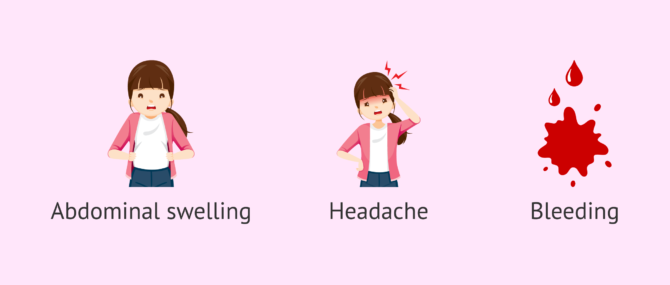
- is a very high response of the ovaries to hormone medication. Many follicles develop, the ovaries overgrow and, after ovulation, the fluid contained in the follicles can pass into the abdominal cavity. Symptoms of this are pain and bloating, nausea, diarrhea, weight gain, etc. In severe cases, ascites, tachycardia, and shortness of breath may occur.
- Risks of egg retrieval
- Ovarian Puncture is a simple surgical procedure performed under sedation. The possible side effects of anesthesia are minor discomfort, dizziness or a drop in blood pressure, but nothing more serious. On the other hand, a complication that can arise during the puncture is damage to the pelvic organs, which can cause bleeding or infection.
If you need more information about all these procedures that take place during IVF, you can read the following article: How is the IVF process step by step?
If you need to undergo IVF to become a mother, we recommend that you generate your Fertility Report now. In 3 simple steps, it will show you a list of clinics that fit your preferences and meet our strict quality criteria. Moreover, you will receive a report via email with useful tips to visit a fertility clinic for the first time.
Embryo transfer and pregnancy
Once the eggs have been fertilized in the laboratory, it is time to transfer the embryos so that they can implant in the mother's uterus and give rise to a pregnancy.
In most countries, however, specialists are allowed to only transfer a maximum of three embryos. The risk of having a multiple pregnancy is still high.
This is what fertility doctor Miguel Dolz confirms:
By law the maximum limit is 3 embryos, generally, we transfer 2, in certain circumstances 3 and we try more and more to transfer only one embryo.
Below, we will discuss this and other pregnancy-related drawbacks of IVF:
- Multiple pregnancy
- since their introduction, assisted reproduction technologies have increased the rate of twin and even triple pregnancies. This fact, added to the age of most IVF patients, means that the risks of pregnancy are higher for both the mother and the babies. IVF-related risk are, for example, premature birth, c-section, fetal death, preeclampsia, etc.
- Miscarriage
- Pregnancy loss in the first few weeks is something that occurs in about 20% of cases. What happens with IVF is that many more biochemical miscarriages are detected than when they occur in a natural pregnancy, as they can be simply mistaken for menstruation.
- Ectopic pregnancy
- ectopic or extra-uterine pregnancy means when the embryo implants outside the uterus, such as in the fallopian tubes, for example. The risk of this happening after IVF is 2-5%, while in a natural pregnancy it is only 1%. This is due to the embryo transfer into the uterus and the likelihood of damage to the fallopian tubes.

If you want to learn more about the types of miscarriages that can happen in early pregnancy, we recommend you continue reading here: Types of miscarriage.
Other possible risks of IVF
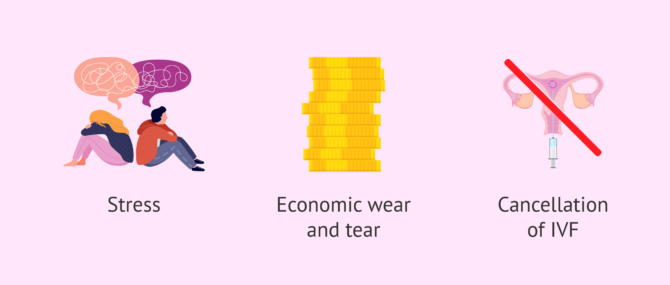
Although the most common risks of IVF are usually those mentioned above, any fertility treatment also involves a great deal of stress.
In the case of IVF, this reproductive option can cause emotional and physical stress, but also financial stress. The probability of pregnancy in the first IVF attempt is not assured and sometimes it is necessary to repeat several IVF cycles until pregnancy is achieved. This involves a large financial investment, which can be stressful for patients.
On the other hand, there is the possibility of having to cancel IVF treatment because of a poor response to medication or because viable embryos are not available for transfer, for example. Fertility centres should also inform patients of the possible risk of IVF cancellation before starting treatment.
In any case, the most important thing is to optimise assisted reproduction treatments to minimise the possibility of side effects and complications. In addition, it is essential to follow medical instructions to limit any IVF risks.
FAQs from users
Does artificial insemination involve the same risks as in vitro fertilization?
All fertility treatment cycles involving ovarian stimulating medication have similar risks but the difference is the degree of severity. For cycles using only oral or injectable fertility medications, the risks of an ectopic pregnancy, ovarian hyperstimulation syndrome and ovarian torsion are less than 5% in both IUI and IVF cycles.
The difference between IUI and IVF are the pregnancy success rates and risk of multiple births. In an IUI cycle using oral medication, the risk of a multiple pregnancy is less than 5% but increase to 10-15% when injectable fertility medications are used.
The unique distinction of IVF is the ultrasound guided vaginal egg retrieval and the ability to transfer a predetermined number of embryos. As a result, the risks with an egg retrieval included intra-abdominal bleeding, injury to the bowel and bladder, and infection. Fortunately, all of complications occur in less than 1% of cycles. Further, the risk of a multiple pregnancy is directly related to the number of embryos transferred: a single embryo transfer has a 1% risk of dividing into a twin pregnancy; a double embryo transfer can increase the risk of a twin pregnancy in up to 40% of cycles.
What other problems can arise during IVF treatment?
Apart from the rather physical risks that may arise during IVF, the psychological and emotional factor is also very present in all assisted reproduction patients. It is possible to suffer strong episodes of stress and anxiety, especially when receiving a diagnosis or a negative result.

On the other hand, financial problems can also arise due to the high cost of fertility treatments. If the treatment is financed, patients may have to spend several months paying for it even if they are not pregnant.
Does in vitro fertilization have any risk for the baby?
There are some studies that claim that children born through IVF have a slightly increased risk of congenital defects: 4.5% compared to 2-3% in the rest of the population. However, it is not proven that this is due to the assisted reproduction technique itself or, instead, to the infertility problems of the parents.
Recently, it has also been shown that children born by assisted reproduction do not necessarily suffer from infertility, since the first IVF child in the world, Louise Brown, was able to become a natural mother in 2006.
Are there any risks or side effects of IVF-ICSI?
Michelle Emblenton, a biochemist at inviTRA, answers this question in the video:
In vitro fertilization with ICSI (intracytoplasmic sperm injection) carries the same potential risks and side effects as a classical IVF procedure.
One of these is ovarian hyperstimulation syndrome. And this is where following the hormonal medication used to stimulate the ovaries, they have been overstimulated. This can result in pain, blow in and swelling in the ovaries. Although this is monitored by ultrasound, it can cause a problem and can lead to your cycle being cancelled while the syndrome is treated. Ovarian hyperstimulation syndrome occurs rarely these days and, if it does occur, is usually of very low severity.
Another risk involved in IVF procedures is multiple births. When more than one embryo is transferred, there is a possibility of a multiple pregnancy. When we transfer two or three embryos the chances of becoming pregnant with twins or perhaps triplets is increased. However, modern techniques allow us to perform many single embryo transfers in order to prevent the risks of a multiple pregnancy. Only in very rare cases are two embryos transfer and it is unlikely that three embryos will be transferred.
Miscarriage is always a possible risk in undergoing IVF procedures, as it is with natural pregnancies, and it is estimated that between 20 and 22% of the procedures end in a miscarriage.
An ectopic pregnancy results when the embryo implants in the fallopian tube rather than in the uterus. This is problematic because the embryo cannot develop and grow there and results in removal of the fallopian tube. Ectopic pregnancies happen in between 2 to 5% of the pregnancies resulting from IVF treatments, whereas with natural pregnancies it's seen between 1 to 2% of the time.
Suggested for you
Another risk of IVF is the possibility that the cycle may have to be canceled due to various complications that may arise during the treatment. You can find out what they are in the following article: When is IVF canceled?
In the case of transferring more than one embryo after IVF, there is a risk of having a multiple pregnancy with serious consequences for the health of the mother and the future baby. It’s important to know what these are. Find it out in the following article: Risks of multiple pregnancy.
We make a great effort to provide you with the highest quality information.
🙏 Please share this article if you liked it. 💜💜 You help us continue!
References
Edgardo Somigliana, Laura Benaglia, Alessio Paffoni, Andrea Busnelli, Paola Vigano, Paolo Vercellini. Risks of conservative management in women with ovarian endometriomas undergoing IVF. Hum Reprod Update. Jul-Aug 2015;21(4):486-99. doi: 10.1093/humupd/dmv012 (View)
Norbert Gleicher, Vitally A Kushnir, David H Barad. Risks of spontaneously and IVF-conceived singleton and twin pregnancies differ, requiring reassessment of statistical premises favoring elective single embryo transfer (eSET). Reprod Biol Endocrinol. 2016 May 3;14(1):25. doi: 10.1186/s12958-016-0160-2 (View)
P Cavoretto, M Candiani 1, V Giorgione, A Inversetti, M M Abu-Saba, F Tiberio 1, C Sigismondi, A Farina. Risk of spontaneous preterm birth in singleton pregnancies conceived after IVF/ICSI treatment: meta-analysis of cohort studies. Ultrasound Obstet Gynecol. 2018 Jan;51(1):43-53. doi: 10.1002/uog.18930 (View)
Ziru Jiang, Yinyu Wang, Jing Lin, Jingjing Xu, Guolian Ding, Hefeng Huang. Genetic and epigenetic risks of assisted reproduction. Best Pract Res Clin Obstet Gynaecol. 2017 Oct;44:90-104 (View)
FAQs from users: 'Does artificial insemination involve the same risks as in vitro fertilization?', 'What other problems can arise during IVF treatment?', 'Does in vitro fertilization have any risk for the baby?' and 'Are there any risks or side effects of IVF-ICSI?'.
Authors and contributors


More information about Michelle Lorraine Embleton



